Why am I so sensitive?
If you keep asking why am I so sensitive, here is a plain look at what sensitivity is, the moments it shows up in, and how seeing your pattern over time softens it.
Reading time: 6 min
A comment lands in the middle of a normal day. Maybe it is a small correction from your manager, a flat tone in a friend's message, or a joke everyone else laughs at. Something in your chest drops, and the next few hours disappear into replaying it. Later the question arrives again, the one you have asked many times: why am I so sensitive?
Here is the honest answer. Sensitivity is usually not a flaw and not a breakdown. It means your system takes in more of what is around it, especially emotional cues, and holds on to them longer. You register the shift in tone, the pause, the tension that others walk past. So the question is rarely whether you feel too much. It is what the feeling is doing, and why the same moment keeps happening.
What may be happening
Sensitivity usually comes from one of two places, and often from both. The first is temperament. Some systems simply take in more, notice subtleties faster, and process them more deeply. People sometimes describe this as being a highly sensitive person. That is a common phrase rather than a diagnosis, and it points at how a nervous system can be built, not at a defect.
The second is adaptation. If you grew up around moods that shifted quickly, or in a place where reading the room was how you stayed safe, your attention became expert at catching small changes. That skill did not switch off when the situation changed. It is still scanning, still reading faces, still bracing for the shift in tone that once meant something.
This is also why being told you are too sensitive can sting more than the original remark. It takes a working system and calls it a flaw. Sensitivity is not fragility. It is attunement, and attunement only becomes a burden when there is nowhere for it to go.
A few things are worth trying. Name the moment before you argue with it, saying something as plain as that landed hard, instead of building a case for why it should not have. Let the feeling sit in your body for a minute before you go hunting for the reason. Then write it down, what happened, what you felt, what you did next, and keep enough of those notes that you can compare them later.
How it tends to show up
- A short reply arrives and the mood of your day tilts, so you reread it looking for what changed.
- An offhand remark stays with you through the afternoon and into the next morning.
- You feel the tension in a room before anyone speaks, and you quietly adjust yourself around it.
- Feedback that is fair and gently worded lands like a verdict on who you are.
- A scene in a film, a song, or a story someone tells moves you to tears and takes you by surprise.
- You replay a conversation at night, rewriting what you wish you had said.
- Someone asks if you are okay, and you say yes, because explaining would cost more than you have.
These moments connect. Crying easily and getting triggered easily are often the same sensitivity arriving through different doors, and over-explaining yourself is often what happens when a feeling starts to seem like something you have to defend.
Why awareness alone may not change it
You may already know all of this. You may have named it, apologised for it, tried to be less. Knowing does not always slow the reaction, because the reaction arrives before thought does. The body responds first, the drop in the chest, the tightening, the rush to make it better.
The pattern also has a job. If you learned early that moods could turn, watching closely was protective. Making yourself smaller, softer, quicker to agree kept the peace. That was not weakness. It was a strategy that worked well enough for long enough that your system kept it.
There is a second layer too. When you have been told you feel too much, you may have started arguing with your own experience. You gather witnesses. You ask three friends whether a message was rude. You shrink the feeling before anyone else can. That argument uses energy that could go toward processing what you actually feel.
What changes things is not a single realisation. It is seeing the shape repeat. The same kind of moment, the same tightening, the same move to explain or withdraw, arriving again weeks apart. Repetition is hard to see inside one day and much easier to see across a month. Once the shape is visible, you are no longer entirely inside it. You have somewhere to stand, and from there overthinking less stops being a demand and becomes something that can actually happen.
A question worth carrying
Sensitivity may not be the thing to fix. What might shift is how you meet the moment when it comes, not by deciding your feelings are wrong, and not by building a case that they are right, but by noticing the familiar shape of it while it is still happening.
What if the feeling is not too much, but simply arrives faster than you have had a chance to understand it?
How Natus approaches this
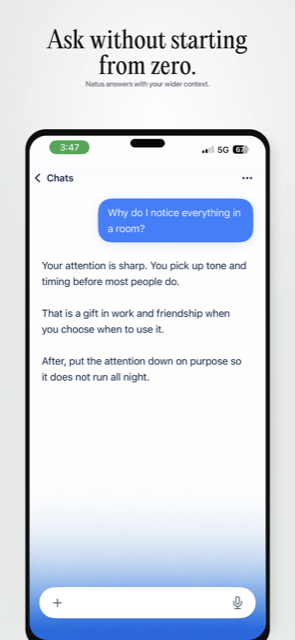
Natus is an iPhone self-discovery companion. It begins with a personal reading drawn from your name and birth details, then offers a daily insight and a diary you can talk to. Because it remembers what you write, it can show you the same moment returning across weeks, the small slight, the fast drop, the familiar reach to explain yourself, rather than treating each day as a fresh surprise.
That does not make sensitivity disappear, and it is not meant to. Natus does not predict the future and it is not therapy. What it offers is a record honest enough that the pattern stops being invisible, so the next time it happens you have something to recognise rather than something to argue with.