How to process emotions
How to process emotions in plain words: what to actually do when a feeling is too big to ignore and too heavy to carry around all week.
Reading time: 6 min
Processing an emotion means letting it finish instead of carrying it around half-felt for weeks. Most people were never taught how, so they do one of two things: push it down, or drown in it. There is a middle way, and it is simpler than it sounds.
The short version: name the feeling in plain words, write it down or say it out loud, let your body do what it needs to do, and come back to it later if it is still there. Here is what that actually looks like.
What may be happening
When a feeling has nowhere to go, it does not disappear. It waits. It shows up as a short temper with the wrong person, a heaviness you cannot explain, or a flat nothing where a feeling should be. If you often feel nothing at all, that is its own thing, and feeling numb is worth reading next.
The reason processing feels hard is that most of us learned to manage feelings instead of having them: stay busy, stay fine, deal with it later. Later never comes on its own.
How it tends to show up
Things that actually help, in plain words:
- Name it plainly. Not "I am overwhelmed." More like "I am scared they will leave" or "I am angry and I do not want to be." The plainer the words, the faster the feeling starts to move.
- Write it down. A few honest lines beat an hour of rehearsing the feeling in your head. It does not need to be good writing. It needs to be true.
- Let your body finish. A walk, a shower, a cry, ten slow breaths can help the feeling finish instead of staying stuck.
- Say it to one safe person. Not for advice. Just so it exists outside your head once.
- Come back later. Some feelings need a second pass tomorrow, when the heat is lower and you can see what was underneath.
Why awareness alone may not change it
Knowing what you feel is not the same as letting it finish. You can name a feeling perfectly and still carry it for months, because naming it is the start of the work, not the end of it.
What helps is repetition, not intensity. One honest page a few times a week does more than one huge emotional purge a year. And if writing only happens when everything breaks, that is worth noticing too: why you might only journal when you are falling apart.
A question worth carrying
If this feeling could say one sentence, what would it say?
How Natus approaches this
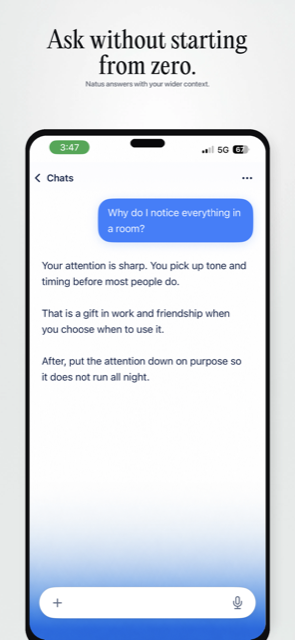
Natus is one honest option for the writing part. It gives you a private place to put the feeling down, then reads your week back in your own words every Sunday, so the things you could not name in the moment start to show up as something you can see. It is a journal that remembers what you wrote last week when you sit down to write this one. If your feelings have gone quiet rather than loud, feeling empty all the time may be the closer read.