Why do I over-explain myself?
Over-explaining is often less about poor communication and more about a learned fear that being understood is never guaranteed.
Reading time: 6 min
You over-explain because being misunderstood has felt costly before. The extra words are insurance: they close every gap where someone could misread you, pull away, or quietly decide something unfair about your intent.
What may be happening
Over-explaining is often treated like a style problem. Talk less. Be more confident. Get to the point.
That advice can miss the emotional job the habit is doing.
If you learned, even without anyone saying it out loud, that people do not reliably take you as you meant yourself, you start pre-empting the miss. You add context. You add disclaimers. You restate the same point three ways. You fill the silence before the other person can fill it with the wrong story.
The drive is not always “I love talking.” It is often “I need there to be no room left for the wrong version of me.”
That version might be: cold, selfish, dramatic, unclear, too much, not enough, hard to love, hard to trust. The exact fear varies. The structure is the same. Words become insurance.
This can make you sound thorough, careful, even generous. It can also leave you exhausted after ordinary conversations, because each one required a full defence of your interior.
How it tends to show up
- You send a short message, then a longer one, then a third that explains the tone of the first two.
- In conflict, you rebuild the whole timeline so the other person will finally see you were reasonable.
- You answer a simple question with the question, your history with the question, and three possible interpretations.
- After a meeting or date, you replay what you said and wish you had said less, then prepare even more carefully next time.
- You feel a spike of urgency when someone seems quiet, delayed, or neutral, and your first move is to clarify yourself rather than wait.
Why awareness alone may not change it
You may already know you over-explain. You may catch yourself mid-sentence and still keep going. That is because the habit is not only a speaking pattern. It is a safety pattern.
The deeper logic is often something like: if I leave any ambiguity, I will be misread; if I am misread, I will lose standing, closeness, or the right to be taken seriously.
So when you try to “just be brief,” your body may experience that as risk, not as polish. Brevity can feel like walking into a room without armour.
Awareness can notice the long message. It does not automatically create the felt sense that a shorter message will still land as care, competence, or honesty. Until that deeper need for safe understanding is named, the extra paragraphs keep volunteering.
This is not a claim that people should stop communicating carefully. Care is different from pre-empting every possible misread. Care chooses what matters. Over-explaining tries to control how you will be held.
It can sit next to other protective moves: pulling away when someone gets close, or knowing the pattern and still staying stuck. Different shape. Same need to stay intact. And if every entry in a journal becomes another chance to re-justify yourself, you will feel why journaling starts from zero.
A question worth carrying
What do you fear people will decide about you if you leave one sentence unfinished?
How Natus approaches this
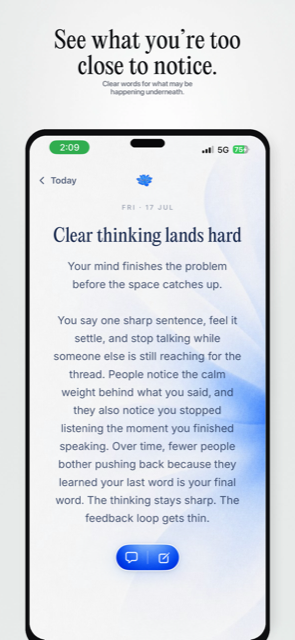
Natus begins with a personal map that already holds context about how you operate, instead of asking you to re-justify yourself from zero in every entry. The aim is recognition of the need under the habit, not a lecture on communication technique.