How to stop overthinking everything?
Why the overthinking loop keeps spinning, why most advice does not land, and what can actually loosen it.
Reading time: 6 min
If you overthink everything, you have probably been told to stop, to relax, to think less, to just decide. And you have probably found that none of it works. That is not because you are failing. It is because that advice targets the wrong layer.
Overthinking is not a habit you can simply switch off. It is a loop your mind runs to feel safe. Until you understand what the loop is protecting, telling yourself to stop will keep bouncing off.
What may be happening
Overthinking is often a way of trying to control the uncontrollable. You replay a conversation to find the exact thing you should have said. You scan a decision for every risk. You run worst case scenarios so you can be ready for them. Each pass feels like progress, like you are one step closer to certainty.
But certainty never arrives. There is always another angle. So the loop keeps going, and the cost builds: you lose sleep, you feel stuck, you second guess things you used to know. The thinking was meant to protect you, and instead it has become its own source of exhaustion.
How it tends to show up
- You replay conversations and reword what you said, sometimes for days.
- You make decisions slowly and often revisit them.
- You struggle to switch off at night because your mind keeps going.
- You ask for reassurance, then do not trust it.
- You feel exhausted from thinking, even when you did not do much.
Why awareness alone may not change it
Knowing you overthink does not stop it, because the loop is doing a job. It is protecting you from the discomfort of uncertainty. As long as uncertainty feels dangerous, the thinking will keep running to scan for it.
This is why advice like "just stop thinking" never lands. It asks you to drop a safety mechanism without giving you anything to replace it with. The useful shift is not to silence the mind. It is to change what you are scanning for, so the loop stops being the only tool you have.
It runs on the same fuel as being self-aware but still stuck, where you can see the loop and still live inside it, and it often makes journaling feel like starting from zero, because a blank page gives the loop nothing to settle against.
A question worth carrying
What would I do with the energy I spend scanning for problems, if I did not have to earn certainty first?
How Natus approaches this
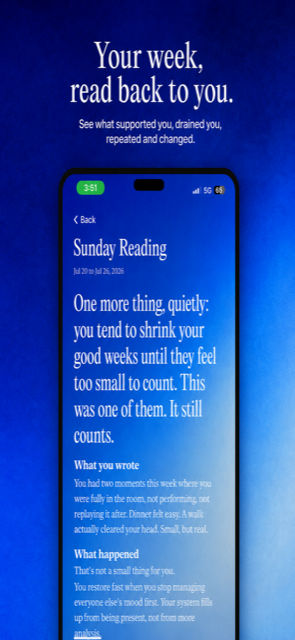
Natus helps you see the shape of how you think, so overthinking becomes something you recognise in the moment it starts rather than something that swallows your whole day. It reads your patterns back to you, built for recognition rather than another list of rules to follow.