Why do I cry so easily?
What it means when tears arrive easily: a low threshold, a build-up of unspoken feeling, and the small moments just before it. A self-recognition look, not a diagnosis.
Reading time: 6 min
You are in a meeting, or halfway through an ordinary conversation, and your eyes fill before you have decided anything. Someone says something kind and you have to look at the floor. Later you wonder what is wrong with you, because nothing that big happened.
If you keep asking yourself why do I cry so easily, here is the short answer. Crying easily is not a flaw in your character. It usually means that what you are carrying has grown close to the size of the container holding it, and tears are how a body releases pressure when a feeling arrives bigger than the room available for it. The question is not whether you are too soft. It is what is filling you up, and how often.
What may be happening
One way to picture this is a threshold. Everyone has an emotional volume setting, and every day adds load: sleep, stress, hormones, pain, the conversations you did not have. When a moment asks more than you have left, tears come. A lower threshold is not weakness. It is a sensitive instrument, and it is often accurate.
The triggers tend to fall into a few shapes. Loneliness. Feeling powerless. Being overloaded. Being moved by something tender. A scene on a screen that gives your own feeling somewhere to land. Only one of those is sadness. Anger, relief, exhaustion and joy all leave through the same door.
Sometimes the load is recent and obvious: a loss, a move, a hard month at work. Sometimes it is older, a long habit of keeping the peace, of not saying the thing, of being the one who copes. Tears can be where all the unsaid sentences finally arrive.
If the tears come with weeks of low mood, a sense of hopelessness, or trouble doing the things you normally do, talking to a doctor or a counsellor is a good next step. This is not a diagnosis. It is care.
A few things that can help
- Watch the ten minutes before, not the tears. The run up holds the information.
- Breathe out longer than you breathe in, and let the first wave pass before you explain anything.
- Say the plain sentence out loud to one person: I am at my limit today.
- Note when it happens, what was going on, and what you needed. Repetition shows up faster than you expect.
- Check the basics. Sleep, food, pain and hormonal shifts all shape the threshold for the day.
- Stop treating the crying as the problem. It is usually the messenger, and it is telling the truth.
How it tends to show up
- Your eyes fill at a kind word faster than at a harsh one.
- You cry in the middle of an argument, which makes it harder to say what you meant.
- A song, an advert or a film scene lands harder than it has any right to.
- You hold it together all day and it arrives at night, in the shower or in bed.
- You are fine until someone asks if you are okay, and then you are not.
- You cry quietly at work, then spend the rest of the day embarrassed about it.
- A short week of little sleep turns everything into a trigger.
Why awareness alone may not change it
Knowing that you cry easily does not change much on its own, because the crying is the last step in a chain that started earlier. A need went unmet. A feeling was set aside. A moment arrived bigger than the space you had made for it. Awareness of the label sits at the end of that chain, after everything has already happened.
Patterns like this repeat because the earlier steps stay invisible. You notice the tears. You do not notice that you skipped lunch, agreed to something you did not want, and spent forty minutes swallowing a feeling. Those are the moments that stack. Being triggered easily and feeling anxious for no reason often travel with this. They come from the same place: a system running hot, telling you through the body first.
Some people swing between crying easily and feeling nothing at all, which is the same system under different pressure.
What shifts this is seeing the sequence across weeks, not once. When you can point to the run up, the tears stop being a mystery and become information. You may still cry, but you stop adding shame on top, and shame is what makes the next wave bigger. The work is less about holding it in and more about giving the feeling somewhere to go earlier, before it has to arrive all at once. That is also why beating yourself up about it keeps the cycle going.
A question worth carrying
It can help to stop asking why you are like this and start asking something narrower, something you can actually answer. Not a verdict about your character, but a look at the minutes just before. The run up is where the information lives. Carry it for a week and the pattern usually starts to show itself.
What was happening in the ten minutes before the tears, and what did I need that I did not say?
How Natus approaches this
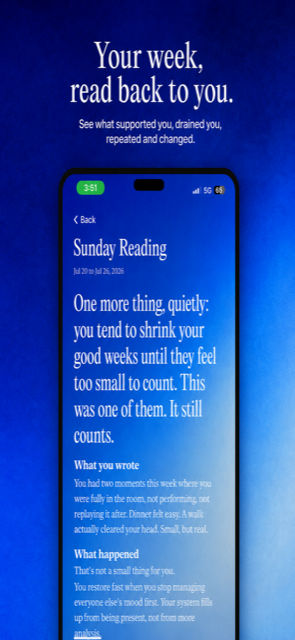
Natus is an iPhone self discovery companion. It reads your name and birth details as a starting map, then offers a daily insight to hold next to your actual day. It does not predict the future and it is not therapy. It is a place to notice what is already there.
The part that matters here is the diary. You can talk to it, and it remembers what you write, so the run up to your tears stops disappearing. Over a few weeks it shows you the shape: the weeks you cried at kind words, the days you had not eaten, the conversations where you swallowed what you meant. Seeing your own pattern is what changes how you meet it.