Why does my inner critic sound like the truth?
The inner critic sounds like truth, which is why it is so hard to question. A look at what the voice is doing and how to recognise it as a pattern, not a verdict.
Reading time: 6 min
There is a voice inside that tells you you are not good enough, that you should have done better, that you are behind, that you have no excuse. It sounds reasonable. It sounds like it has your best interests at heart. And because it sounds so much like the truth, it is the hardest voice to question.
If this sounds familiar, you may be wondering about your inner critic. It is a common thing to carry, and naming it can help. The point of this page is not to diagnose you or to tell you the voice is wrong about everything. It is to help you see what the critic is doing, so you can meet it with more understanding instead of more compliance.
What may be happening
The inner critic is rarely trying to hurt you. It believes it is keeping you on track. It watches for your mistakes before someone else can, points out your flaws before the world can, and keeps your standards high so you do not get comfortable and fall behind. From its perspective, it is doing you a favour.
The problem is that it does its job with no sense of proportion. It treats a small slip as proof of a deep failing. It generalises one moment into a verdict about who you are. And because it has been running for so long, you stopped hearing it as a voice and started hearing it as simply what is true.
The critic is not your real judgement. It is a protective habit built from an early lesson that being hard on yourself was safer or more effective than being kind. It sounds like truth partly because it is so familiar.
How it tends to show up
- You finish something and immediately focus on what went wrong, not what went right.
- You compare your inside to other people's outside and come up short.
- You rehearse your mistakes at night, replaying them in detail.
- You dismiss praise as if it must be mistaken.
- You hold yourself to a standard you would never set for anyone you love.
Why awareness alone may not change it
You may already know you have an inner critic. You may have read about it, named it, even tried to silence it. Naming it does not always quiet it, because the critic is doing real work. It believes that if it stops watching, you will fall apart or fall behind. As long as that belief holds, the critic keeps its job.
Recognition becomes useful when it moves from "my critic is right" to "I have a voice that sounds like truth but is not the whole truth." It is not about pretending you never make mistakes. It is about hearing the voice as a voice, with a purpose you can name, instead of as the final word on who you are.
The critic is a central part of not being able to see your own patterns, because it keeps your attention on your flaws. It helps drive repeating the same patterns, as the self-criticism becomes another reason to feel stuck. And it can make knowing who you really are feel impossible, because it is always telling you who you are not.
A question worth carrying
If the critic stopped talking for a day, what would you finally be able to hear?
How Natus approaches this
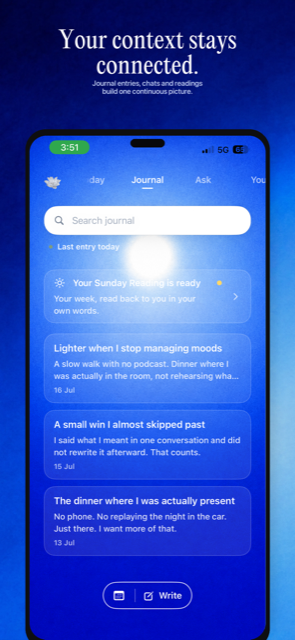
Natus starts with a personal map of how you operate, so the voice that sounds like truth becomes recognisable as a pattern with a purpose, not as the final word on who you are. It reads your week back against that map, built for recognition rather than a demand to simply stop criticising yourself.