Why do I keep repeating the same patterns?
Repeating a pattern is rarely a failure to learn. It usually means some part of you still believes the old move is keeping you safe. A clear look at the logic underneath repetition.
Reading time: 6 min
You can see it coming, and then you do it anyway. The same kind of person, the same withdrawal right when something could actually land, the same decision to wait until the moment has passed. Repeating a pattern is not the same as failing to learn. It usually means some part of you still believes the pattern is keeping you safe.
What may be happening
A pattern rarely repeats because you are stubborn or slow. It repeats because it once worked. The move that kept you safe when you were small, or carried you through a hard stretch, does not retire on its own just because it stopped being necessary. The part of you that first built it does not check the date. It checks for safety, and the old move still feels like the reliable one.
So you end up living inside a familiar shape. It feels like "you" because you have re-entered it so many times, not because it fits who you are now. That is why repetition can feel so defeating. You are not starting fresh each time. You are returning to a room your system has decided is safe, even when the room is clearly costing you.
This is worth slowing down for: repetition is usually not a lack of awareness. It is awareness of the outcome without awareness of the job the pattern is still doing. You see that it happened again. The quieter part of you sees a familiar landing place and walks there without asking whether it is still the safest room.
How it tends to show up
- You recognise the situation early, feel almost detached, and then act from the pattern anyway.
- You meet someone new who seems different, and a version of the same old dynamic quietly reappears.
- You leave before things get real, or you stay long past the point that is good for you.
- You tell yourself this time will be different, and it is, right up until the familiar trigger arrives.
- You can list your patterns fluently to a friend, then watch one fire in real time an hour later.
Why awareness alone may not change it
Being able to list your patterns is a real skill. It does not change them, because the behaviour is still earning something. Naming it describes the result. It does not answer what the repeat is for.
Often the pattern is protecting a vulnerable guess: that closeness ends badly, that hope is unsafe, that being seen means being judged, that finishing is riskier than staying stuck. The pattern keeps re-running so you never have to test that guess and risk being proved wrong.
That is why insight alone can start to feel circular. You get better and better at explaining the repetition, and the repetition keeps the same job. It often runs alongside waiting until you feel ready, self sabotage, or choosing the same type of person. Different scenes, same protective logic.
Change usually begins when recognition goes one layer under the behaviour. Not only what you repeat, but what that repeat still believes it is guarding you from. That is the same gap as being self-aware but still stuck, where you can narrate the whole loop and still live inside it. Seeing the story and feeling safe outside it are two different things.
A question worth carrying
What would this pattern have to stop protecting before I could act differently?
How Natus approaches this
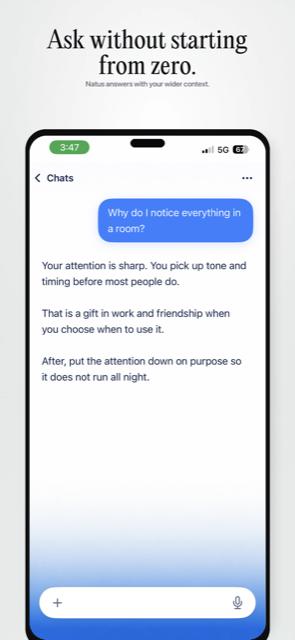
Natus does not ask you to spot your patterns from a blank page. It starts with a personal map of how you operate, then meets what you write against that map, so a repeating move becomes recognisable in the moment instead of only after the cost. The aim is recognition that lands before you act, not another label you apply after the fact.