How to stop beating yourself up
Beating yourself up is a motivational strategy that feels like accountability and works like erosion. What to actually do instead of just noticing it.
Reading time: 6 min
"I spent 25 years mistaking self-punishment for self-improvement."
The plain answer: you stop beating yourself up by stopping the deal underneath it. The beating is a motivational strategy wearing the clothes of honesty: if I am hard enough on myself, I will finally change. You cannot quit the punishment while you still believe the punishment is what keeps you growing.
So the work is narrower than silencing the voice. Catch the beating while it is happening, and ask what it is actually trying to accomplish. Arguing with it and obeying it both keep you inside it.
What may be happening
The part of you that beats you up thinks it is a coach. A harsh one, maybe the only kind that ever worked on you. It watches for mistakes and treats each one as proof you need more pressure. "I used to beat myself up every single day that I'm not motivated enough" is how it sounds from inside: the punishment arrives on schedule, dressed up as standards.
What it never notices is the bill. Being beaten up leaves you smaller, more tired, and more likely to quit the things that were helping. You end up needing recovery from your own self-improvement.
How it tends to show up
- A mistake gets a speech, not a note. You relive it with commentary.
- You call yourself names you would never say to a friend in the same situation.
- Rest feels unearned. Fun feels suspicious. You have to deserve them first.
- Compliments bounce off because they do not match the internal record.
- When something goes well, the voice moves the goalpost before you can feel it.
Why awareness alone may not change it
Most people who beat themselves up already know they do it. Knowing does not stop it because the voice believes it is the only thing standing between you and falling apart completely. If it goes quiet, it predicts laziness, drift, failure. It will not retire on the strength of being noticed.
The move that actually helps is separating what happened from what you made it mean. "I snapped at my friend" is an event. "I am a terrible person" is the beating. One is workable, the other is just pain wearing a whistle. There is a whole page on why the inner critic sounds like the truth; this page is about what to do while it is talking. And if self-help itself has become another stick to beat yourself with, why self-help apps can make you feel worse names that trap directly.
A question worth carrying
If I spoke to a friend the way I speak to myself, what would I say to them instead?
How Natus approaches this
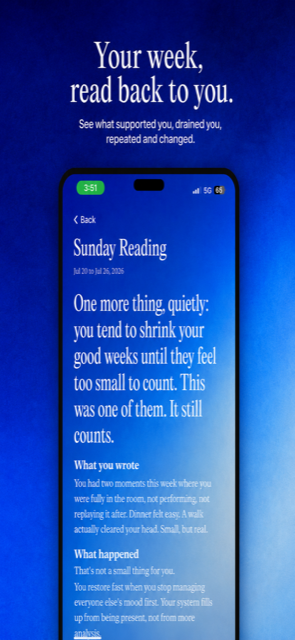
Natus starts with a personal map of how you operate, so the harsh voice becomes a pattern you can see instead of a verdict you live under. It reads your week back in plain words, so the gap between what actually happened and what you made it mean becomes visible on paper, where it is harder to argue with. Recognition, not a demand to love yourself by Friday.