I don't know who I am
When you don't know who you are, identity is not something you invent. It is something you notice, in the small steady things that stay true across rooms and years.
Reading time: 6 min
I don't know who I am. Who am I really? However the question arrives, it is one of the most honest things a person can ask, and one of the hardest to answer. If you have asked it, you already know the answer does not arrive like a fact. It does not come from a quiz, a label, or a single dramatic moment.
Identity is less something you invent and more something you notice. It is not a fixed thing you are missing. It is a set of small, steady truths about you that are already there, waiting to be seen.
What may be happening
Most people who ask this are not empty. They are used to being defined by context: by their job, their relationships, their role in every room. When the context shifts, the self can feel shaky, because it was built to respond to others rather than to hold steady on its own.
This is common, and it is not a flaw. It is the result of being good at adapting, at pleasing, at reading the room. The cost is that when you ask who you are when no one is watching, the answer can be quiet, because that self never had much practice speaking.
How it tends to show up
- You know who you are with other people, and are less sure of who you are alone.
- Your sense of self changes with your audience.
- Describing yourself feels like listing roles, not describing a person.
- You envy people who seem to know exactly what they want.
- You worry there is no real you underneath the adaptation.
Why awareness alone may not change it
Knowing you want to find your real self does not deliver it, because identity is not a discovery you make once. It is built through a steady relationship with your own wants and preferences, repeated over time, until the things that are true of you become too loud to ignore.
The useful move is not to force a grand "who am I" answer. It is to start noticing the small, stable things that hold across rooms and years: the moments you feel most like yourself, the things you choose when no one is watching, the opinions you hold even when they cost you. Those are the threads of a real self, and they are already there.
It sits at the centre of finding yourself and understanding yourself better, and it deepens with self reflection.
A question worth carrying
What is still true about me in a room where no one is watching?
How Natus approaches this
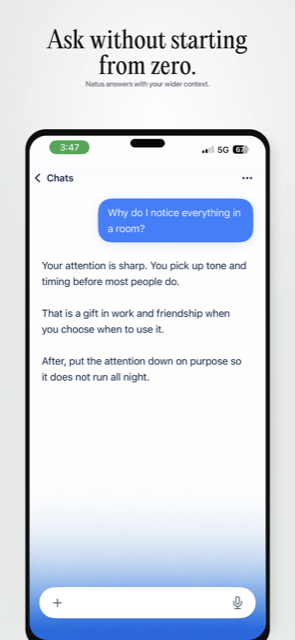
Natus starts with a personal map of how you operate, so you are not trying to discover who you are from a completely blank page. It is a self discovery app that gives you a reference point of your own, read back against what you write and notice each week, built for recognition rather than a label you have to invent or perform.