Why can't I see my own patterns?
Your own patterns are often the hardest to see, not because you lack insight but because they are built into the way you look. Why self-blind spots are so stubborn.
Reading time: 6 min
It can be baffling to watch other people's patterns clearly and miss your own. You can see a friend repeat the same mistake for years, and not notice that you have been doing something equally repetitive for just as long. This is not a lack of intelligence or insight. It is a structural feature of looking at yourself from the inside.
What may be happening
You cannot see your own patterns because you are inside them. A pattern is not an object in front of you. It is the shape your attention takes. The way you pull away, over-explain, or wait until you feel ready feels like simply "how things are," because it has always been the frame you see through.
There is no outside vantage point built into your own life. You experience your behaviour as the normal way to respond, because you have never experienced anything else as your own. What looks like an obvious loop to a friend looks like common sense to you.
Another part of it is protective. Seeing a pattern clearly can be costly. If you fully see that you have been pushing people away for years, you also have to sit with everything that cost. A part of you may quietly keep the picture slightly blurry so you do not have to feel that weight all at once.
How it tends to show up
- You can describe a friend's repeating mistake in detail, but go blank when asked about your own.
- You feel surprised by your own behaviour, as if someone else wrote it.
- When someone names a pattern of yours, you feel a sting of recognition and a pull to explain it away.
- You think of your life as a series of separate events rather than a repeating shape.
- You ask "why does this keep happening to me?" without ever wondering what you are re-entering.
Why awareness alone may not change it
Even when a pattern is finally pointed out to you, seeing it once does not keep it visible. The default is for the pattern to slip back into the background of your attention, where it feels like normal life again. This is why a single flash of recognition fades so quickly.
What keeps a pattern visible is not more effort at watching yourself. It is a stable reference that you can hold your days up against. Without that reference, you keep asking the same question, "why does this keep happening," and missing that you are answering it every time you re-enter the same move.
This is tied to a few other things. It is close to feeling numb, where the pattern becomes hard to feel, let alone to name. It runs alongside pushing people away and pulling away when someone gets close, where the pattern is so close to your sense of self that it feels like a fact about the world rather than a choice you keep making. And it connects to being self-aware but still stuck, because seeing a pattern after the fact is not the same as seeing it in the moment.
A question worth carrying
What would I notice about myself if I were watching my life as closely as I watch other people's?
How Natus approaches this
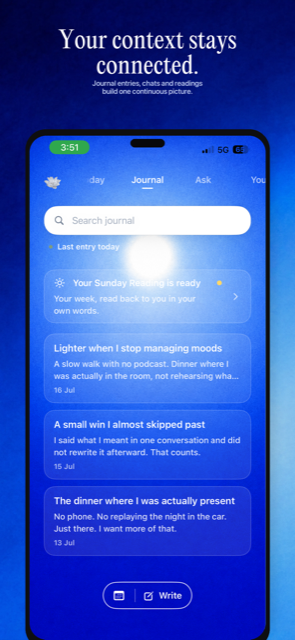
Natus gives you a reference to hold your days against, so a pattern does not have to stay invisible until someone points it out. It starts with a personal map of how you operate and meets what you write against that map. Over time the shape you keep re-entering becomes visible from inside your own life, instead of staying hidden until it has already cost you something.