How to Know Yourself Better
Knowing yourself better means testing what you believe about yourself against what you actually do. Five questions and a way to check each one.
Reading time: 5 min
Knowing yourself better is not about collecting more facts about your past. It is about closing the gap between the story you tell about yourself and the way you actually behave. You close it by testing each belief against real days, rather than thinking about yourself more.
What may be happening
Most of us know our story very well. We can narrate our childhood, our patterns, our reasons, and we do it fluently. That fluency feels like self-knowledge, and it is not. The story is a summary, and summaries leave out the parts that do not fit.
The reason people feel they know themselves yet keep getting caught out is that the story and the behaviour have drifted apart. You believe you are someone who does not need approval, and you check your phone for a reply three times. Both can be true at once. Knowing yourself better means noticing where the two disagree, because that gap is the useful part.
How it tends to show up
These are the signs that you know your story far better than your patterns.
- You describe yourself confidently, but a close friend would add an asterisk.
- You are surprised by your own reactions, as though someone else did them.
- You can explain a mistake beautifully after the fact.
- You feel like a different person in different rooms, and cannot say which one is real.
- Your advice to others is clearer than anything you manage for yourself.
Sit with five questions this week, one a day if you like. What did I do today that I would not have predicted? Where did I act against what I say I value? Which person brings out a version of me I do not recognise? What did I avoid? What did I do when no one was watching?
Why awareness alone may not change it
Answers to those questions are only useful if you can trust them, and memory is a poor witness. It edits toward the story. So the discipline is not more reflection, it is a written record you cannot quietly rewrite. One line a day is enough. The point is that the line is dated and honest, so next month you are reading evidence, not a memory of evidence.
This is also why advice rarely lands. Someone can tell you who you are and be right, and you still will not believe them, because belief comes from seeing it in your own record. That is the same wall behind advice that never sticks. And if you often feel like a different person around different people, your record will show you whether that is flexibility or something you are hiding from yourself.
A question worth carrying
If my life were read back to me as a list of what I actually did, which beliefs about myself would survive, and which would I have to give up?
Try this. Take one thing you are sure about yourself, something like "I am not a jealous person". For one week, note any moment that tests it, without judging the moment. At the end, compare the belief with the notes. You will learn more from one disagreement than from a month of thinking about it.
How Natus approaches this
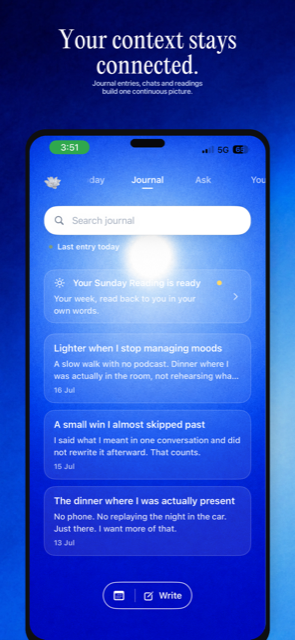
Natus keeps the honest record for you. It starts with a personal blueprint from your name and birth details, then reads what you write against it, so your real days sit next to the picture you have of yourself.
That comparison is the whole point. It shows you where your story and your behaviour line up and where they quietly split, which is where knowing yourself actually moves forward. You can begin on your own with the what am I good at quiz. Or start learning how you actually work and get your first reading free.
Common questions
- How do I get to know myself better?
- Test what you believe about yourself against what you actually did this week. Knowing your story is memory and easy to rehearse. Knowing your patterns needs evidence from real days, so keep a short honest record and read it back.
- How long does it take to know yourself better?
- There is no finish line, but you see the first real patterns in about two weeks of short, regular notes. The point is not to settle who you are once. It is to keep updating the picture as you change.
- What is the difference between knowing your story and knowing your patterns?
- Your story is the tidy account you tell about yourself, with reasons and turning points. Your patterns are what you actually do, over and over, often against your own story. The gap between the two is where most self-understanding happens.