How to be more self-aware
Being more self-aware is less about gathering insight and more about seeing yourself while the moment is still open. Why insight arrives late, and what changes that.
Reading time: 6 min
"I want to understand my own patterns."
You probably already understand a lot of them. You have read the books, named your attachment style, explained your childhood to a friend with real clarity. And still, in the moment that matters, you do not see yourself coming. You only see it afterwards, in the retelling.
The honest reframe is that being more self-aware is not the same skill as understanding yourself. Understanding is what you build afterwards. Awareness is what is available while the moment is still open. The gap between those two skills is where most people live. Most of us practise the first one for years and wonder why the second one never turns up.
What may be happening
Self-awareness usually gets built backwards. You live the week, then you look at it and explain it. That produces a story that is accurate and late. During the moment itself, your attention is fully spoken for: the other person's face, the task, the room, what to say next. There is no spare attention left to notice yourself, so the noticing has to wait until there is.
Waiting is the problem. By the time you have room to notice, the moment has become a memory, and you are explaining something that cannot be changed. The explaining feels like growth, and it keeps the pattern exactly where it is.
There is another reason the backwards version feels so satisfying. Explaining yourself is a skill you have practised for years, and you are good at it. You can take a week and turn it into a story with a beginning and a cause and a lesson at the end. It sounds like understanding, and the following week runs the same way as the last one.
How it tends to show up
- You understand your pattern perfectly in the evening and repeat it the next afternoon.
- You can explain why you reacted, but only after someone else points it out.
- A reading or a book lands hard for an evening, then fades by Thursday.
- You notice what you are doing when you are already halfway through doing it.
- You give good advice about your own situation, weeks after you needed it.
- Your clearest insights are always in the past tense.
Why awareness alone may not change it
Seeing clearly is real progress and it is not enough on its own, because an insight needs somewhere to land. An observation with no home becomes one more thing to think about, and thinking about it can feel like working on it for months.
The other limit is timing. Awareness in the moment needs something to compare against while the moment is still moving, and if the only thing you have is a blank page and a good intention, there is nothing to compare with. This is also not a matter of trying harder to be present. Presence is a small resource in the middle of a hard conversation, and it is already fully used by the conversation itself. This is the same gap behind why you cannot see your own patterns, and it is why being self-aware but still stuck is such a common place to end up.
A question worth carrying
What would I notice about myself if I were not busy explaining myself afterwards?
How Natus approaches this
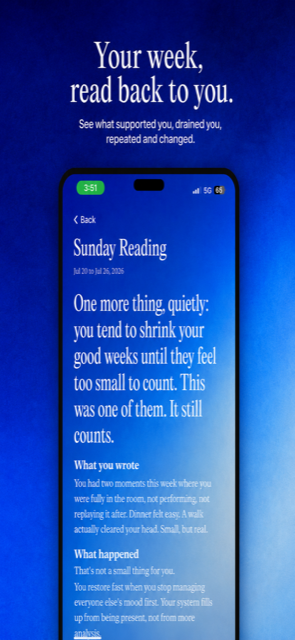
Natus builds a personal map from your name and birth details, so there is a picture of how you operate before the week starts. Then it reads what you write against that map, which means your entries get compared with something rather than simply stored.
That comparison is what makes awareness available earlier. Over time you can see which moments you always explain the same way, and what tends to be happening just before the pattern starts. Not a promise you stop missing things. A shape you can check yourself against while the week is still going.