Why does advice never stick?
Advice can name a better move without touching the part of you that still treats the old move as protection. That is why insight can feel true and still leave your week unchanged.
Reading time: 6 min
Advice never sticks when it describes a better move without reaching the part of you that still believes the old move keeps you safe. You can agree with every sentence and still do the familiar thing under pressure.
What may be happening
Advice often arrives as a clean instruction: set a boundary, text less, sleep earlier, speak up, let it go. On a calm afternoon, the instruction can sound obvious. You nod. You screenshot it. You tell a friend, "I know what I need to do."
Then the live moment arrives. Someone goes quiet. A deadline tightens. A person you want gets closer. Your body votes before your notes do. The advice stays true in theory and unavailable in practice.
That gap is not usually stupidity. It is a mismatch between a general tip and a personal protective logic. The tip addresses behaviour. The logic addresses safety, belonging, control, or dignity. Until that logic is seen as yours, advice becomes another language you can speak fluently without living inside.
How it tends to show up
- You save posts that describe you perfectly, feel briefly relieved, then forget them by Thursday.
- Friends say, "You already know the answer," and they are right, and nothing moves.
- You restart the same plan every few weeks with fresh resolve and the same ending.
- You can coach other people through problems you still repeat in your own life.
- You feel almost offended when advice is too simple, because the simplicity does not match how sticky the pattern feels from inside.
Why awareness alone may not change it
Awareness can collect advice the way a shelf collects books. More titles do not automatically change the room.
The deeper issue is recognition. Advice says what people should do. Recognition names why you keep doing what you do, in your timing, with your cost. Without that, every tip competes with an older strategy that has already proven it can get you through a hard night.
So advice can fail for a quiet reason: following it would ask you to drop a protection before you trust what replaces it. Your mind may want the upgrade. Your system may still prefer the known cost.
This is the same structure as being self-aware but still stuck. It also explains waiting until you feel ready: readiness becomes another condition that postpones the move the advice named. And if you only seek answers when everything breaks, you will also only journal when you are falling apart, collecting crisis tips instead of a map that holds ordinary days.
A question worth carrying
What does the advice ask you to risk that your old pattern still refuses to risk?
How Natus approaches this
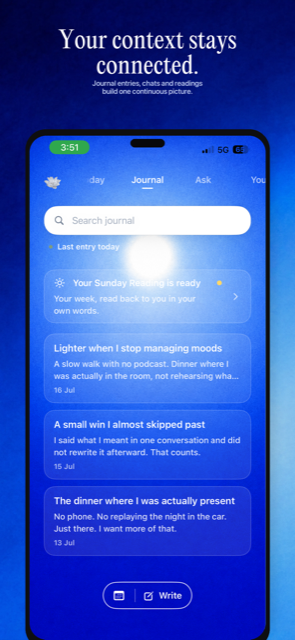
Natus is not another advice feed. It starts from a personal map built from your name and birth details, then meets what you write against that map. The aim is recognition of how you operate, so the next move can finally land against something already true.