How do I understand myself better?
Understanding yourself is less about collecting more insights and more about meeting a map that already exists. Why self-knowledge feels so close and so far at the same time.
Reading time: 6 min
Most of us have tried to understand ourselves by reading more, journaling more, and waiting for the insight that finally makes everything click. That method has a quiet flaw. It treats yourself as a mystery you have to solve from scratch every time. Understanding yourself better usually starts from a map, not from a blank page.
What may be happening
When you want to understand yourself, you are usually not starting from nothing. You already know more than you can say. You know that you freeze in certain rooms, that you hold back with certain people, that you say yes when you mean no. You know your patterns even when you cannot explain them.
The problem is that this knowing is scattered. It lives in feelings and half-finished thoughts, in things you noticed and did not follow. Without a shape to hold it, the knowing stays fragmented. So you keep searching for a clearer version of yourself, and the clarity keeps slipping because you have nowhere to put what you already know.
This is different from lacking self-awareness. It is closer to having a lot of material and no frame for it. You end up overthinking the same moments, rereading the same journals, and asking the same questions, because the material keeps circling without landing anywhere.
How it tends to show up
- You read something that feels deeply true for an evening, then it fades and you feel lost again.
- You journal about the same issue repeatedly and get no closer to a next step.
- You know your triggers well, yet still feel like you do not really know who you are.
- You can analyse other people easily, but your own life stays blurry to you.
- You keep hoping one more insight will finally make you feel settled and understood.
Why awareness alone may not change it
Insight on its own is temporary. It gives you a flash of recognition, and then the week resumes. The reason is that insight does not give you continuity. It does not hold today, last month, and the pattern you keep returning to in one place.
This is why the search for self-understanding can turn into a loop of its own. You gather another framing, feel briefly seen, and soon need the next one. That is close to why journaling can feel like starting from zero, where every blank page asks you to rebuild the whole picture of yourself before you can write a single honest sentence.
Understanding yourself better rarely comes from one more explanation. It comes from having a stable shape that your real days can be compared against, so a single evening or a single entry stops needing to do all the work. It is also tied to finding yourself, which is less about discovering a hidden person and more about recognising one that has been showing up all along. And when you can name your own shape clearly, the stuckness of being self-aware but still stuck often becomes visible in a way it never could while everything felt blurry.
A question worth carrying
What would I stop re-explaining to myself if I already had a clear picture of how I operate?
How Natus approaches this
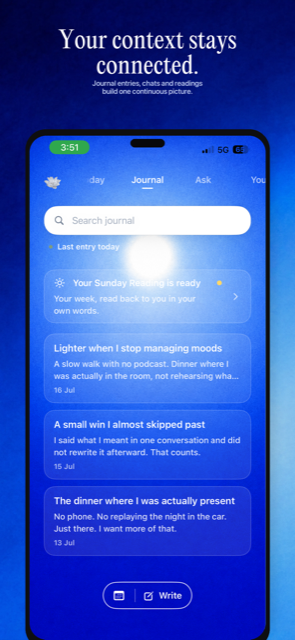
Natus does not ask you to build a model of yourself from scratch. It starts with a personal map based on your name and birth details, then meets what you write against that map. The writing becomes about adding to a shape that already exists, not about generating your whole identity on demand. Understanding yourself stops being a search and becomes a meeting.