Why do I feel like a different person around different people?
Changing around different people is normal. Feeling like none of those versions is really you can point to a pattern worth seeing more clearly.
Reading time: 6 min
Feeling different around different people is normal. Most of us speak differently with a close friend, a parent, a partner, or a boss. The problem is not that you adapt. It is when the adapting feels so complete that you leave each room wondering which version was actually you.
You may be warm and funny with one group, quiet and careful with another, capable at work, then unsure at home. None of those versions has to be fake. But if they feel disconnected from each other, it can leave you tired, hard to know, and strangely alone in your own life.
What may be happening
You may have become very good at reading a room. You notice what gets approval, what creates tension, what people need, and what role is open for you. Then you adjust before anyone asks. It can look like being easygoing, socially skilled, or simply considerate.
Often, this starts as a useful way to stay connected. If being liked, needed, or unproblematic helped you feel secure, you learned to meet the moment first and check in with yourself later. After enough years, the adjustment can become automatic. You do not decide to become a different person. You just arrive there.
That does not mean there is no real you underneath. It may mean your attention has been trained outward for a long time. The versions of you are real responses to real settings. The missing piece is a steady sense of what stays true across all of them.
How it tends to show up
- You feel clear about what other people want, and blank about what you want.
- You agree quickly, then feel annoyed or flat later.
- Friends from different parts of your life would describe you in completely different ways.
- You rehearse how to act before a room, call, date, or family event.
- You feel relief when you are alone, then struggle to describe who you are without an audience.
- You worry people would not like you if you stopped being the version they expect.
The feeling is often not dramatic. It can be a quiet thought after a conversation: I was there, but I do not know if that was really me. Repeating that thought can make your own preferences harder to hear.
Why awareness alone may not change it
You may already know you change around people. Knowing it does not stop it because the pattern has a job. It keeps connection smooth, lowers the risk of conflict, and protects you from the uncertainty of showing a less managed version of yourself.
That is why telling yourself to "just be yourself" can feel useless. It skips the harder question: which parts of you have been safe enough to show, and which parts have been edited out before they can speak? The goal is not to act the same everywhere. It is to notice when you are adapting by choice and when you are disappearing by habit.
This can sit beside not knowing who you really are, or feeling like you have no identity. It can also grow from understanding everyone else better than yourself. Those pages look at the same pattern from different angles: attention going outward so quickly that your own signal gets quiet.
A question worth carrying
When I leave a room feeling unlike myself, what did I think I needed to be in order to stay welcome?
How Natus approaches this
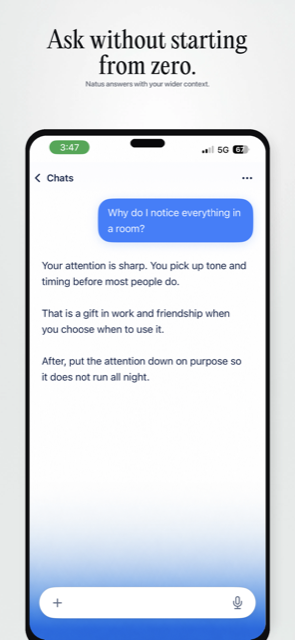
Natus starts with a personal map of how you operate, so you have a reference point that does not change with the room. It helps you notice the patterns that show up across your week in your own words, built for recognition rather than labels or a performance of self-knowledge.