Leaving a therapy app? What to try instead
If you are leaving a therapy app, what usually drove you out was one of three things: a subscription that would not cancel, a chatbot that felt like talking to a script, or exercises behind a paywall at the exact moment you opened up. The honest landing spots: Natus if you want your own patterns read back rather than scripted prompts, stoic if you want plain structured reflection, or real therapy if what you need is treatment. An app is not a therapist, and the good ones do not pretend to be.
What people say in their own reviews
Verbatim from public 1 and 2 star App Store reviews of other apps in this category, not Natus.
Not free at all1 star review on Clarity
Made me feel great pouring my heart out into those questions only to get hit with a paywall. That's a very predatory time to ask them to open their wallet.
This app gives me anxiety, stress, and anger.1 star review on Ahead
I have cancelled my subscription twice now and am still being charged.
The app needs a memory2 star review on Clarity
I want it to remember so that I don't have to repeat myself, as it gets mind bogging. It should be like a normal person who remembers the things they've spoken.
Not even slightly helpful1 star review on Ahead
Literally suggests the most basic common sense things that I've already tried for years and years. The chat feature just repeats everything I say and has no actual truth or insight.
The options
Natus(this is us)
Best for: being read rather than processed
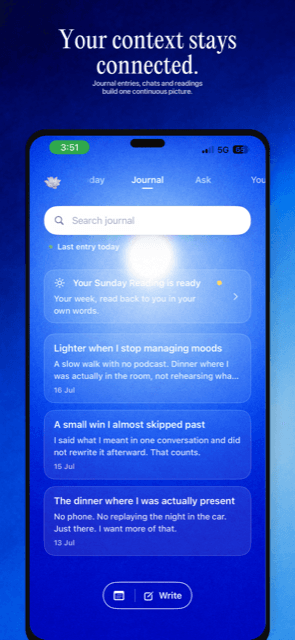
Not a therapy app and honest about it. A First Reading built from your details, a private journal, and every Sunday your week read back so the pattern gets named. It does not run exercises on you; it shows you what you already wrote.
stoic
Best for: structured reflection without the chatbot
Plain morning and evening prompts, no fake conversation. Reviews warn about surprise trial charges, so if you try it, set your own reminder before the trial ends.
How We Feel
Best for: naming the emotion in the moment
A free-feeling emotion tracker backed by a nonprofit, with none of the billing complaints that dominate this category. Limited depth, but nothing predatory.
A real therapist
Best for: when what you need is treatment
Worth saying plainly: if you are struggling, the reviews of these apps are a warning, not a path. A journal helps you see yourself; a therapist treats you. Natus complements the second; it cannot replace it.
What the reviews say goes wrong
Three failures repeat across every therapy-flavored app we reviewed: charges that continue after cancellation, intake quizzes that end in a paywall at the most vulnerable moment, and chatbots that forget what you told them and recycle advice you could have found in a fortune cookie.
The honest question underneath
Most people leaving these apps do not want a robot therapist. They want to be understood. That is a different job, and it is the one Natus was built for: your own writing, read back against a reading of how you operate, every Sunday.
The line we will not cross
If what you need is treatment, get treatment. No journal app, ours included, is a therapist. What Natus can do is make the work between sessions less invisible: what kept coming up, what set it off, what your week was actually about.
Common questions
- Is Natus a therapy app?
- No, and it does not pretend to be. It is a journal that reads back: it shows you your own week and names what keeps coming up. It pairs well with therapy; it is not a substitute for it.
- Why do therapy app reviews complain so much about billing?
- Because the charge lands on people at a vulnerable moment. The reviews repeat the same story: pour your heart into an intake quiz, hit a paywall, cancel, get charged anyway. It is the single most common complaint across this category.
- What can a journal do that a therapy chatbot could not?
- Remember you, honestly. Reviewers complain the chatbots repeat scripts and forget what you told them last week. Natus's Sunday read-back works from your actual entries, so what it reflects is real, not generated small talk.