Why do self-help apps make me feel worse when I'm already trying?
Some products mistake sharpness for honesty. When you are already trying, a call-out can feel like punishment instead of recognition.
Reading time: 6 min
Self-help apps make you feel worse when you are already trying because they often arrive as a verdict instead of a mirror. You opened the door looking for clarity. You got a tone that assumed you were not making an effort.
What may be happening
There is a style of product voice that treats intensity as depth. It names your worst fear quickly. It pushes. It sounds bold. On a strong day, that can feel bracing. On a day when you are already holding yourself together, it can feel like being shoved.
You may already know the pattern. You may already be trying a quieter, kinder approach. A message that implies laziness, denial, or drama does not meet that effort. It overwrites it.
So the worse feeling is not always "the truth hurt." Sometimes the product simply missed the fact that you showed up already in motion.
How it tends to show up
- A notification ruins a morning that was otherwise steady.
- You feel scolded for a pattern you were already watching carefully.
- You close the app angrier than when you opened it, then blame yourself for being sensitive.
- Generic toughness gets mistaken for personal honesty.
- You keep returning because you want recognition, then leave feeling smaller.
Why awareness alone may not change it
You can tell yourself "ignore the tone" and still flinch. Tone lands in the body before the analysis arrives.
The deeper issue is what you came for. Many people are not looking for a coach with a megaphone. They are looking for a clear naming of how they operate without being turned into a problem to fix in public.
That is why generic readings and advice that never sticks fail in different ways: one is too vague, the other is too pushy. Both miss recognition. And if you only open these tools in crisis, seeking answers when everything is already broken makes harsh tone land even harder. The same gap shows up as self-aware but still stuck: you already know; you needed to be met, not prosecuted.
Another layer: when a product cannot see your effort, it fills the gap with assumption. Assumption often defaults to "you need a push." If you already pushed yourself to open the app, the extra shove lands as contempt.
You may start to distrust your own tenderness. You came for recognition and left rehearsing a harder voice against yourself. That is a costly trade.
Useful honesty names a pattern without demoting the person living it. If the line could only work by making you feel behind, it is probably not recognition. It is pressure wearing a clever outfit.
A question worth carrying
What kind of honesty would still feel like care on a day when you are already trying?
How Natus approaches this
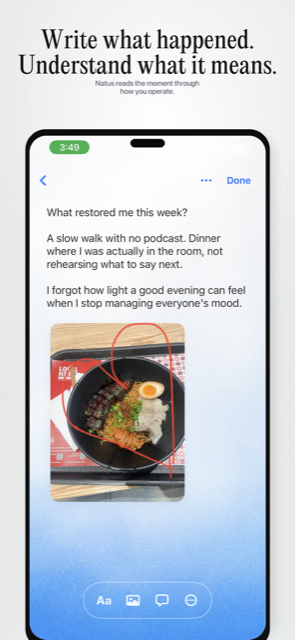
Natus is built for recognition, not call-outs. It starts from a personal map and aims for the quiet "oh. that's me." moment, without turning your effort into a failing grade.
If streak guilt or paywalled progress is part of what wore you down, the Finch alternatives page covers the gentler options honestly.