Why do I ruin good things?
You ruin good things because ending it yourself beats waiting for it to end. How that habit forms, how it shows up, and what loosens it.
Reading time: 5 min
You ruin good things to end the uncertainty of something working. If you end it yourself, you never have to wait to see if it could have broken on its own.
What may be happening
When something good arrives, it carries a risk that difficulty does not. A good relationship, job, or chance means you can lose it. It means you can be let down. It means other people and outcomes get a vote.
If that uncertainty feels unbearable, your system may reach for a familiar fix: end it first. Pick the fight, find the flaw, quit, get distant, say the thing that cannot be unsaid. The destruction is painful, but it is pain you chose, and choosing is safer than hoping.
It can also be about not trusting the good thing. If you have learned that goodness is temporary, you may not believe it can last. So you end it early, on your terms, rather than wait for the moment it inevitably turns.
How it tends to show up
- You pick a fight or find a flaw right after a stretch of things going well.
- You get restless or critical when a relationship feels too smooth.
- You quit or pull away when a good thing starts to feel real.
- You make a small damaging comment you cannot take back.
- You feel relief after ending it, then regret it once it is gone.
Why awareness alone may not change it
Knowing you ruin good things does not stop you, because the ruin is doing a job. It is resolving an unbearable uncertainty. The pattern only loosens when you can tolerate a good thing staying good without needing to control how it ends.
That tolerance is built slowly. It usually means noticing the urge to ruin as a signal, not a command, and giving the moment a pause: this is the part where I normally end it. What would happen if I let it keep going? The answer is often more bearable than the fear that drives the move.
It often travels with self destruction and pulling away when someone gets close.
The hard part is that ruining good things is rarely loud. It can be a small distance that becomes a habit, a critique you voice more often than a compliment, a decision you make alone that the relationship should have made together. By the time you name it, you may already be half out the door. That is part of the pattern: the move is designed to be hard to catch because it is built to avoid being stopped.
Catching it sooner is not about willpower. It is about knowing your own signals, the exact shape of the moment right before you normally end something, and being able to name it as it happens. That is where a reference point helps: when you recognise the move as familiar, it loses some of its power to feel like the only option.
A question worth carrying
What am I so afraid of losing, that I end it before it can be taken?
How Natus approaches this
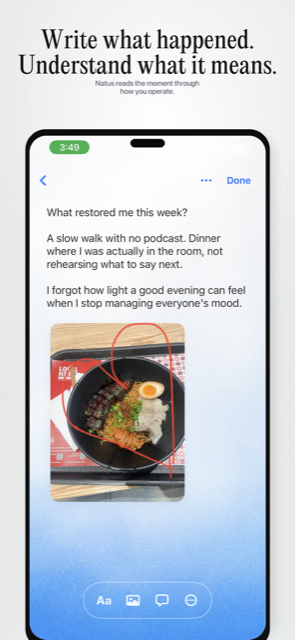
Natus gives you a place to see the pattern in your own words before it plays out. It starts with a personal map of how you operate and reads your week back against it, so the urge to ruin something good becomes recognisable as a familiar move, not an inevitability. Recognition first, built for steadiness rather than pressure.