Why do I wait until I feel ready?
Waiting for readiness can feel responsible. Underneath, it can be a way to avoid the moment where certainty will not arrive before the choice.
Reading time: 6 min
You wait until you feel ready because readiness sounds like wisdom. In practice, it can become a moving finish line that protects you from choosing while certainty is still incomplete.
What may be happening
Some decisions deserve care. Waiting can be respect for timing, information, or emotional capacity. That version of waiting is clean.
There is another version. In that one, "ready" means: no doubt left, no risk of looking foolish, no chance of needing someone, no possibility of choosing wrong in public. That kind of readiness rarely arrives, because life rarely offers a sealed guarantee before the move.
So you research a little more. You wait for a clearer feeling. You wait for the other person to make it obvious. You wait for Monday, for after this month, for when work settles, for when you feel more like yourself. The calendar keeps moving. The threshold stays just ahead of you.
From the outside it can look like patience. From the inside it can feel like being stuck in the doorway with your hand on the handle.
How it tends to show up
- You know what you want to say and rehearse it for weeks without sending it.
- Opportunities expire while you wait for a more confident version of yourself to appear.
- You collect information long after you have enough to choose.
- You feel calm while postponing, then sharp regret when the window closes.
- "Not yet" becomes your most fluent sentence, even when the cost of waiting is clear.
Why awareness alone may not change it
You can see the stall and still wait, because waiting is doing a job. It keeps you from the exposure of a real yes or no.
The deeper logic is often: if I move before I feel ready, I will have to live with uncertainty in public. If I wait, I can protect the fantasy that a future self will choose cleanly. Waiting preserves the idea of a perfect later.
That is why advice like "just do it" so often fails here, and why advice never sticks for this pattern. The tip attacks delay. It does not touch the safety of unfinished choice.
It also links to being self-aware but still stuck: you can narrate the exact cost of waiting and still prefer the known discomfort of not deciding. Over-explaining can become the waiting room's soundtrack: more words, more conditions, more rehearsals. And when a helpful practice finally starts, abandoning what helps can arrive the moment it asks for consistency instead of a perfect mood.
A question worth carrying
What does waiting protect you from having to survive after you choose?
How Natus approaches this
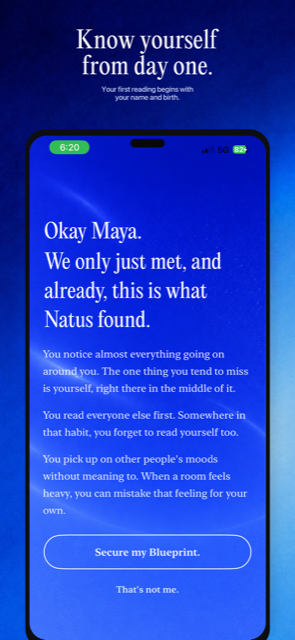
Natus does not wait for you to feel fully ready before offering a first map. It begins with your name and birth details, then meets real life as it happens. Recognition can arrive before confidence does. That is often the point.