Why do I keep abandoning what helps me?
Helpful practices often die when they stop feeling urgent, start asking for consistency, or threaten the identity that was built around almost-changing.
Reading time: 7 min
You keep abandoning what helps you because help often arrives with a second cost: consistency, visibility, or a quieter identity than the one that lives in almost-starting again. The start feels hopeful. The stay asks for a different self.
What may be happening
The beginning of a helpful practice is charged. New notebook. New app. New morning routine. New promise. For a few days, effort and relief travel together. You feel like someone who is finally taking care of herself.
Then the novelty thins. The practice asks to be repeated on ordinary Tuesdays. It asks you to return without a crisis soundtrack. It may even start working enough that the old emergency identity softens. That soft landing can feel strangely empty if intensity was how you knew something mattered.
So you drift. You miss two days. Shame rises. Restarting feels heavier than the original start. The tool joins the graveyard of almosts: journals, planners, readings, stretches, therapy worksheets, voice notes to yourself.
People often call this lack of discipline. Often it is a clash between a helpful system and the emotional economy that made crisis, delay, or reinvention feel more like you.
How it tends to show up
- You are excellent at day one and quiet by day eight.
- You buy the nicer version of the tool right before you stop using the first one.
- You feel most committed when explaining the new plan to someone else.
- Once something actually helps, you get restless and look for the next framework.
- You tell yourself you will return when life calms down, then only return when life breaks again.
Why awareness alone may not change it
You can list every abandoned practice and still repeat the cycle, because the cycle may be protecting something.
Sometimes it protects you from the vulnerability of being seen as someone who needs help in an ongoing way, not only in a dramatic reset. Sometimes it protects the freedom of being unfinished. Sometimes it protects you from discovering that help will not make you feel ready before you still have to live your life.
Awareness names the drop-off. It does not automatically make continuity feel like home.
This sits next to only journaling when you are falling apart: help gets used as an emergency brake, then parked. It also links to journaling feeling like starting from zero, where every return rebuilds context from scratch. The same protective stall shows up as waiting until you feel ready, and as being self-aware but still stuck when you can narrate the whole graveyard of almosts without changing the ending.
A question worth carrying
What does staying with what helps ask you to become that restarting again lets you postpone?
How Natus approaches this
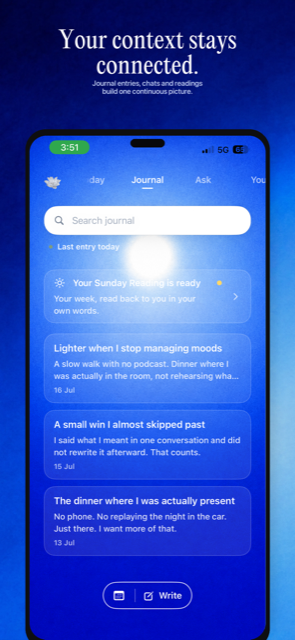
Natus is built for continuity, not another dramatic restart. Your First Reading begins with a map that is already yours, so returning does not require inventing yourself from a blank page each time life softens or breaks.