Why do I only journal when I'm falling apart?
Crisis writing feels urgent and true. Calm days make the blank page feel optional, so the record becomes a museum of hard nights instead of a living map.
Reading time: 6 min
You only journal when you are falling apart because pain raises the cost of staying silent. Calm lowers that cost. The page gets used as an emergency exit, not as a place that already knows you on ordinary days.
What may be happening
Crisis makes writing feel necessary. Something hurts enough that holding it alone feels worse than putting it down. The entry comes out messy, long, and honest. You leave feeling slightly less alone with yourself.
Then the storm passes. The next quiet morning does not demand the same urgency. Opening the journal can feel like inventing a problem, performing feelings, or restarting a habit you already "failed" at last month.
So the archive fills with peak nights: breakups, spirals, fights, sleepless hours. The middle of your life stays missing. When you return later, you meet a version of yourself who only appears under pressure. That can make the journal feel heavy to open again.
This is not proof you are dramatic. It is often proof the tool only feels worth the effort when the pain is loud enough to override the blank page.
How it tends to show up
- You write three pages at 1 a.m., then nothing for three weeks.
- You only open the app after a fight, a rejection, or a wave of dread.
- Rereading old entries feels like visiting a crisis museum, so you avoid it.
- On good days you think, "I should write," then close the app because nothing feels bad enough.
- You promise yourself you will journal consistently next Monday, then wait for the next collapse to actually do it.
Why awareness alone may not change it
You can know that regular writing would help and still only write in emergency mode. Knowing does not create continuity. Continuity needs a page that already holds you when nothing dramatic is happening.
The deeper logic is often: if I am not in pain, the page has no job. If the page has no job, writing feels fake. If writing feels fake, I wait until it feels true again. Truth, in this setup, is defined as intensity.
That is close to why journaling feels like starting from zero. A blank page asks you to generate context every time. Crisis supplies context for free. Calm does not. So calm loses.
It also pairs with being self-aware but still stuck: you can describe the binge-write cycle clearly and still repeat it, because the cycle still feels like the only honest door into the page. And when every return requires a fresh crisis, you may also keep abandoning what helps you the moment life softens.
A question worth carrying
What would have to already be true on the page for you to write on a quiet day?
How Natus approaches this
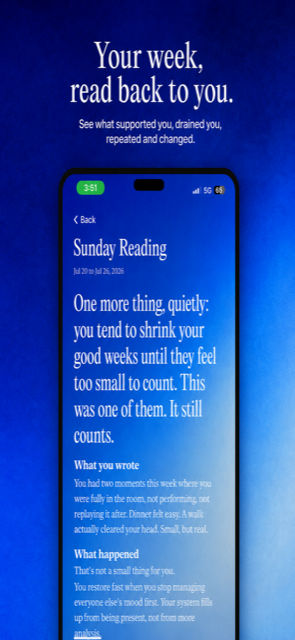
Natus begins with a personal map from your name and birth details, so the first page is not empty and writing does not need a crisis to feel justified. You can still write when things fall apart. You just do not need falling apart to have somewhere to begin.