Why does journaling feel like starting from zero?
Journaling feels like starting from zero because a blank page asks you to supply all the context yourself. Here is why it feels like work, and what changes it.
Reading time: 7 min
Journaling feels like starting from zero because most journals hand you a blank page and ask you to supply the whole world: who you are, what matters, what repeated, and what any of it means. The page waits. You do all the labour.
What may be happening
People often blame themselves for “not being consistent writers.” That story is incomplete.
A blank journal is not neutral. It is a demand. It asks for energy on days when energy is already low. It asks for honesty without offering memory. It asks for meaning without holding continuity.
So you sit down and face a quiet stack of jobs:
- Remember what happened.
- Decide what is worth writing.
- Find words that do not feel fake.
- Interpret those words later.
- Connect today to last month without a system that does that for you.
No wonder the notebook becomes something you mean to return to. The intention is real. The interface is expensive.
This is especially true if you are already self-aware. You do not need another empty box that says “how do you feel?” You need a place that already knows the shape you keep living inside, so writing can meet something rather than invent everything. That is the same gap as being self-aware but still stuck: description without a living map.
Every journal starts blank. That is the default product. The emotional cost of that default is easy to miss until you notice how often you open the app, stare, and close it.
How it tends to show up
- You buy a new notebook or app with hope, write for four days, then stop without drama.
- You reread old entries and feel like you are meeting a stranger who never got a reply.
- Prompts feel generic, so your answers stay generic, and the habit dies of boredom.
- You only write in crisis, so the journal becomes a museum of hard nights rather than a living record.
- You want reflection, but the blank page feels like performance: produce insight on demand.
Why awareness alone may not change it
You can know journaling is “good for you” and still avoid it. That is not laziness in most cases. It is a rational response to a tool that makes you rebuild context every time.
The deeper issue is continuity. Without a personal map that exists before the entry, each page is an island. You become the librarian, the witness, the analyst, and the person in pain at once.
Awareness of the avoidance (“I never stick with journals”) does not remove the design problem. The design problem is that the product assumes you will carry the memory of you.
What changes the experience is not more discipline slogans. It is a first page that is not empty: a sense that something already knows your patterns, your timing, your way of pulling close or pulling away, so your writing has a place to land. Without that, you keep over-explaining yourself even on the page, or replaying the same relationship shape without seeing the role you keep re-entering.
A question worth carrying
If the page already knew you, what would you stop having to re-explain every time you write?
How Natus approaches this
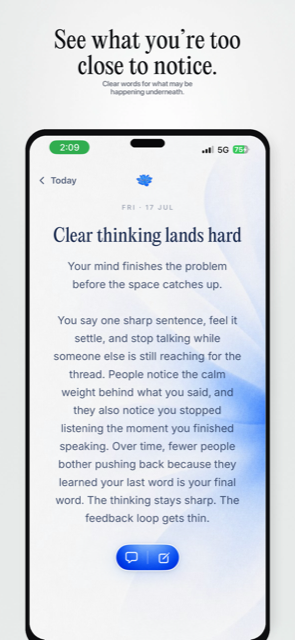
Natus is a private journal that already knows you before you write a word. Your name and birth details become the beginning of a map that is already yours. You still write. You just do not start from zero. Every journal starts blank. Natus starts already knowing you.