Why do I feel like I have no identity?
Feeling like you have no identity usually means other people have defined you for so long that nothing feels like yours. What rebuilds it.
Reading time: 5 min
Feeling like you have no identity is usually not that you are empty. It is that your sense of self has been built mostly from other people, and when they are not there to reflect it back, there is nothing solid to hold onto.
What may be happening
Some people grow up with a clear, stable sense of who they are. Others learn early that being seen means being what the situation needs. You become an excellent mirror: different in every room, fluent in other people's expectations, quick to adapt. It works. People like you, rely on you, describe you as easygoing.
The cost is that when the room empties, so does the self. If your identity lives in how you adjust to others, then alone there is no one to adjust to, and you can feel like a shape with nothing inside.
This can also follow a period of heavy caretaking, survival, or constant adapting. Identity built on responding to others leaves little practice for asking who you are when no one is asking anything of you.
How it tends to show up
- You have a strong sense of who you are in relation to others, and a blank space alone.
- You change hobbies, interests, and even opinions based on who you are around.
- Describing yourself feels like listing roles, not describing a person.
- You envy people who seem to "just know" what they want.
- Being alone for a while makes you feel untethered or vaguely anxious.
Why awareness alone may not change it
Knowing you lack a stable identity does not give you one, because identity is not something you can decide on like a fact. It is built through a reliable relationship with your own wants, preferences, and boundaries, repeated over time.
If you have spent years orienting outward, the inward signal may be faint. When you ask yourself what you want, the answer may be a guess or an echo of whoever is nearby. It can feel safer to keep adapting than to risk discovering a self you are not sure exists.
The useful move is not to force a dramatic "who am I" answer. It is to start noticing the small, stable things that are true of you across rooms: the moments you feel most like yourself, the things you choose when no one is watching. Those are the first threads of an identity that belongs to you.
This page is not a diagnosis. It is a frame for a feeling that is common, painful, and often misunderstood as emptiness when it is actually a self that was never given room.
It often appears alongside feeling disconnected from yourself and understanding everyone else better than yourself.
A question worth carrying
What is still true about me in a room where no one is watching?
How Natus approaches this
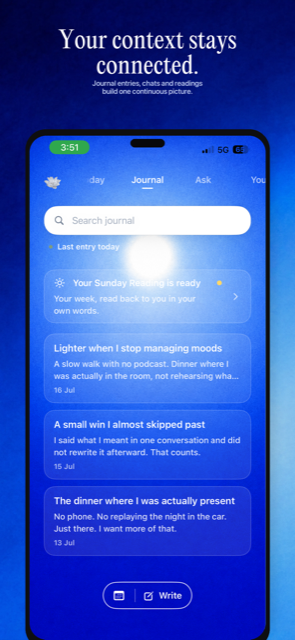
Natus starts with a personal map built from your name and birth details, so there is a reference point of your own from the first page. It is not a personality test or a label. It is a starting shape to recognise yourself against, built for people who have spent too long being defined by others.