Why do I keep starting over instead of continuing?
A fresh start can feel cleaner than an imperfect streak. Restarting protects the fantasy of a better self who never has to return mid-thread.
Reading time: 6 min
You keep starting over instead of continuing because a clean beginning feels lighter than an honest middle. Middles have history, missed days, and a self who already broke the plan once.
What may be happening
Starting over offers a costume change. New notebook. New app. New Monday vow. For a moment you get to be the person who has not failed this yet.
Continuing asks something harder: return after the gap without erasing it. That can feel like walking into a room where your unfinished attempts are still on the table.
So the restart is not always laziness. It can be a way to protect dignity, hope, or the fantasy that the next version of you will finally do it cleanly.
How it tends to show up
- You are excellent at day one and quiet by day eight.
- You rename the habit instead of resuming it.
- Shame after a miss makes restarting feel easier than returning.
- You collect beginnings the way other people collect routines.
- Continuity feels strangely heavier than another dramatic reset.
Why awareness alone may not change it
You can see the restart loop and still prefer it, because continuing would expose you to an imperfect record.
The deeper logic may be: if I continue, I have to be the person who already slipped. If I start over, I get to be new. That logic links to abandoning what helps and waiting until you feel ready. It also thrives in tools that forget what you keep coming back to, because nothing holds the middle for you. And it sits inside self-aware but still stuck: you can narrate the graveyard of fresh starts without changing the ending.
Starting over also protects you from being witnessed mid-failure. Continuity means someone, even only you, can see the gap in the record. A new beginning erases the exhibit.
In products this shows up as another signup, another blank journal, another perfect plan. In relationships it can look like another almost-connection instead of repairing the one that already knows you.
The irony is that continuing is usually where trust in yourself is built. Restarting keeps hope vivid and evidence thin. Hope without evidence feels exciting. Evidence without perfection feels adult, and adulthood can feel strangely unromantic to a nervous system trained on fresh starts.
A useful reframe: continuing is not the opposite of ambition. It is ambition with a memory. The next chapter can include the missed days without needing a costume change.
A question worth carrying
What does continuing ask you to face that starting over lets you postpone?
How Natus approaches this
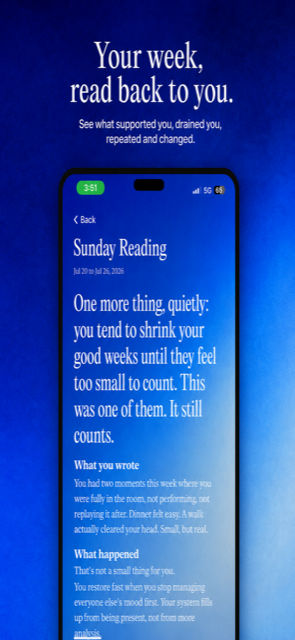
Natus is built for continuity rather than another dramatic reset. Your First Reading begins a map you can return to, so the middle of the story does not have to be thrown away to feel possible again.