Why do I feel disconnected from myself?
Feeling disconnected from yourself can come from living mostly on the outside, in roles and responses instead of your own needs.
Reading time: 5 min
Feeling disconnected from yourself often means you have been living mostly on the outside: in roles, in responses to other people, in what you should do, while the quieter part of you that wants and feels has been waiting.
What may be happening
Disconnection from yourself is rarely the absence of an inner life. It is more often the result of being trained, early or gradually, to treat your own wants as less important than what is expected, what is safe, or what keeps others comfortable.
You learn to check the room before checking yourself. To answer what people need before asking what you need. To describe yourself through roles: the reliable one, the calm one, the one who never causes trouble. Over time the roles get very good, and the person inside them gets quieter, until you can perform your life smoothly and still feel like you are watching it from a small distance.
It can also appear after a period of surviving. When energy has been spent managing, adapting, and keeping things stable, there may be little left over to ask what you actually want. Disconnection can be a low-level way of not having to face how tired, angry, or unsure you are.
How it tends to show up
- You are great at knowing what others need and unclear on what you want.
- Your preferences feel faint, or you borrow them from whoever is near.
- You feel like a version of yourself in situations, rather than yourself.
- Big decisions feel like guesses, because you are out of practice hearing your own voice.
- You feel most "real" alone, and slightly rehearsed around others.
Why awareness alone may not change it
Noticing that you feel disconnected does not reconnect you, because connection to yourself is not an idea. It is a practice of turning attention inward and staying there long enough to hear something.
If you have spent years treating your own wants as secondary, the inner voice may be thin or critical. It may sound like a list of shoulds rather than a sense of direction. Turning toward it can feel uncomfortable, like meeting someone you have been avoiding.
The useful step is not to demand a clear answer from yourself immediately. It is to give the quiet part permission to speak at all, without immediately editing it for other people. Over time, the person you have been performing starts to become optional.
This page is not a diagnosis. It is a frame for a distance that many people live inside without ever naming it.
It often appears alongside understanding everyone else better than yourself and feeling boring when things are stable, when calm reveals how little room the inner self has had.
A question worth carrying
When did I last let myself want something without immediately asking if it was allowed?
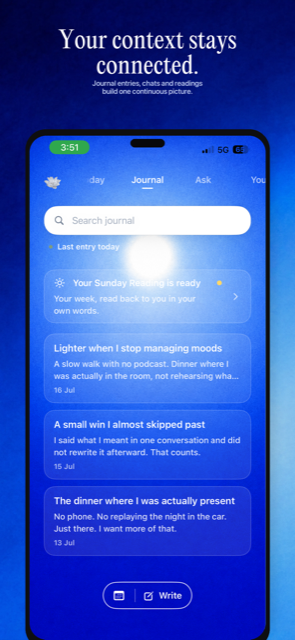
How Natus approaches this
Natus starts with a personal map of how you operate, so your own shape is not a blank page you have to invent from scratch. It gives the inner voice a starting reference point, built for recognition rather than a list of habits or labels.