Why do I feel anxious for no reason?
Feeling anxious for no clear reason usually means your body caught something before your mind did. Here is what that feeling often carries.
Reading time: 6 min
Feeling anxious for no reason usually has a reason. It just has not been named yet. Your body reacts to things your mind files away without reading: a conversation that sat wrong, a week with no rest in it, a worry you keep postponing. The tightness arrives without a label, which is what makes it so hard to argue with.
If this sounds familiar, the point of this page is not to diagnose you or make a medical claim. It is to help you look at what the feeling might be signalling, so you can meet it with more understanding instead of more frustration.
What may be happening
Feeling anxious "for no reason" often still has a reason; the reason is just not the one you are scanning for. You are probably looking for a big, recent, external cause: a conflict, a deadline, a change. But the feeling can be carrying something quieter, something that has been building without a headline moment.
It might be an unmet need you have been postponing. It might be a decision you are avoiding. It might be a pattern of putting everyone else first that leaves you running on empty. It might be a background hum of self-criticism that has been on so long you stopped noticing it. The knot is often the part of you that knows something is off but cannot yet say what.
This is not about finding one perfect explanation. It is about treating the feeling as information worth looking at, rather than a glitch to be ashamed of.
How it tends to show up
- You feel tense or uneasy without a clear trigger you can name.
- You scan your life for a reason and find nothing big enough.
- The feeling shows up most when you finally slow down, as if it had been waiting.
- You worry that something is wrong with you for feeling this way.
- The uncertainty of "no reason" makes the anxiety feel more confusing, not less.
Why awareness alone may not change it
Knowing there is usually a quieter reason does not always dissolve the feeling, because the feeling is not waiting for you to label it. It is carrying something, and until that something is acknowledged, the knot keeps its job. Telling yourself "there is nothing to worry about" can actually make it worse, because it treats a real signal as if it were noise.
Recognition becomes useful when it moves from "I feel anxious for no reason" to "something is signalling, and I can get curious instead of ashamed." It is not about forcing the feeling away or diagnosing it. It is about giving it enough room to show what it is pointing at.
The habit of treating every feeling as a problem to fix is close to overthinking everything, and it often lives beside being self-aware and still stuck, where you can name the pattern but cannot yet reach its root. It can also be tied to not seeing your own patterns until they surface as an unexplained feeling.
A question worth carrying
If this feeling could talk, what would it be asking you to notice?
How Natus approaches this
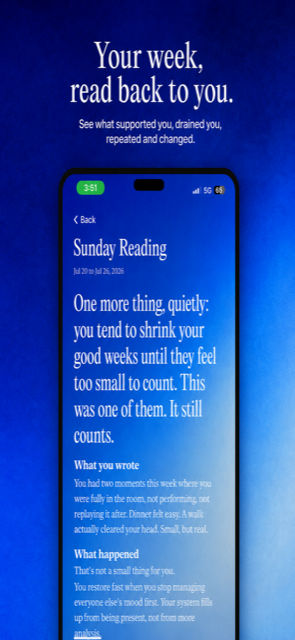
Natus starts with a personal map of how you operate, so a feeling that seems to come out of nowhere becomes traceable to patterns you can recognise. It reads your week back against that map, built for recognition rather than medical claims or a demand to simply calm down.