How do I deal with constant worrying?
Constant worrying is a scanning habit that feels like responsibility. Why your mind keeps the background tab open and what that stance is protecting.
Reading time: 6 min
"I make myself sick with how much I worry."
If that line could be yours, here is the plain answer: constant worrying is a stance, and a very common one. Somewhere along the way, your mind decided that staying worried is how you stay responsible, loving, and prepared. Stopping feels like not caring. So the worry never gets put down, because putting it down feels like dropping your guard.
What may be happening
Worry dresses up as problem-solving, but it does not solve. It rehearses. Real problem-solving ends in an action. Worry ends in another worry, because its job was never to find an answer. Its job is to keep watch.
For a lot of people, watching is how love feels. Worrying about your kids, your partner, your family can feel like the caring itself. If you stopped scanning, who would be paying attention? That is the deal the worry made a long time ago: vigilance equals love, equals safety, equals being a good person. Nobody ever renegotiated it.
And the stance keeps proving itself. The disasters you worried about mostly never came, which quietly feels like evidence that the worrying worked.
The cost is that the scanning never clocks out. One worry resolves and the next loads instantly, the way one tab closes and another was already open behind it.
How it tends to show up
- A worry gets resolved and a new one takes its place before you even exhale.
- Relaxing comes with guilt, like you are neglecting something you cannot name.
- The people you love occupy a permanent background tab of what-ifs.
- Worry feels productive while it is happening, and leaves nothing solved.
- You have been told to stop worrying so many times it now feels like one more thing you are doing wrong.
Why awareness alone may not change it
"I know I worry too much" is the sentence worriers say most, and it changes nothing. Because worry is a stance you are standing in, and stances do not respond to arguments. You cannot talk yourself out of one. You can only see what it is built on.
The shift that helps is getting curious instead of combative. Not "stop worrying," but "what does my worrying think it is doing for me?" Usually the answer is some version of: it thinks it is protecting the people and things you love from your inattention. That is a purpose you can respect and still put down. The worry often escalates into catastrophizing, where the scanning jumps straight to the worst outcome, and it overlaps with feeling anxious for no reason, where the signal shows up without an obvious source.
A question worth carrying
If my worry could talk, what would it say it is protecting?
How Natus approaches this
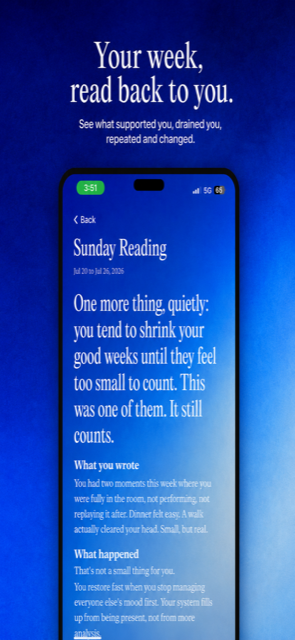
Natus starts with a personal map of how you operate, so the scanning habit becomes something you can see from a step back instead of something running in the background of every hour. It reads your week back against that map, so what your worry keeps circling becomes visible as a pattern with a purpose. Not a promise the worry stops. A vantage point where you can finally see what it has been guarding.