How do I find myself?
Finding yourself is less about a big answer and more about turning attention inward long enough to hear your own wants.
Reading time: 6 min
Finding yourself does not usually mean discovering one hidden true version of you. It means rebuilding a steady relationship with your own wants, needs, and boundaries, after years of defining yourself through other people.
What may be happening
If you feel lost, you may be very good at being who other people need. You adjust smoothly. You know what to say in every room. And somewhere along the way, the version of you that exists when no one is watching got quiet.
"Find yourself" sounds like an adventure: quit, travel, have a revelation. For most people it is quieter than that. It is relearning to hear a voice that was never given much room, and trusting that voice enough to act on it.
You are not empty. You are out of practice. The self is not missing. It is just used to being asked last.
How it tends to show up
- You are clear about what others want and vague about what you want.
- You feel most like yourself alone, and slightly different with each group.
- Big decisions feel like guessing, because you do not trust your own preference.
- You borrow opinions and hobbies from whoever is near.
- You wonder if other people "just know" who they are and you missed the memo.
Why awareness alone may not change it
Knowing you are lost does not find you, because finding yourself is not an idea. It is practice. It is turning inward repeatedly, waiting past the discomfort, and writing down what you actually want without editing it for an audience.
The inner voice is often thin or critical at first. It may sound like a list of shoulds instead of a sense of direction. That is normal. A voice that has been ignored does not speak clearly on the first try. The way to strengthen it is to give it somewhere safe to speak, over and over, until it stops checking the room first.
A useful starting point is a stable reference: a sense of your own shape that does not depend on whoever is in front of you. With a reference point, reflection stops being a blank page and starts being a conversation with a self you can see.
It often sits near feeling disconnected from yourself and feeling like you have no identity, where the trouble is not emptiness but a self that never had room.
A question worth carrying
What do I want when no one is watching, and why is that answer hard to say out loud?
How Natus approaches this
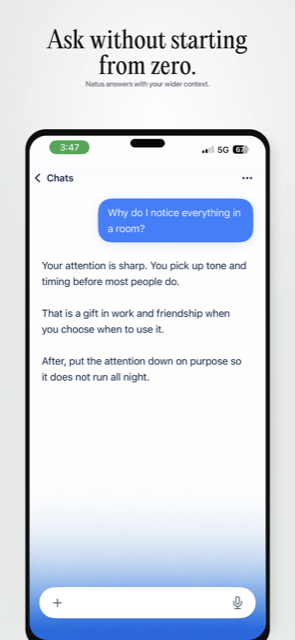
Natus gives you a starting map built from your name and birth details, so you are not trying to find yourself from a completely blank page. It is a reference point of your own, met against what you write each week, built for recognition rather than a personality label or a to-do list.