What should I do with my life?
What should I do with my life is usually a pile of smaller questions. Here is what the question is really asking, and where to get your own evidence.
Reading time: 7 min
Start with what you already keep doing when nobody is paying you, then test it against what your life can actually carry. "What should I do with my life" is not one big question. It is a pile of smaller ones about work, money and time.
That can read as vague advice, so here is the version that works. Stop trying to choose a whole life in one decision. Start gathering evidence about what you are like across many ordinary days, because one big choice is guesswork until you have that evidence.
What may be happening
People who ask this are rarely lazy or broken. Two things are usually true at once. The old plan, the one you inherited or drifted into, has stopped fitting. And you do not yet have your own data to replace it with.
The feeling is common and it is loud. "What should i do with my life" gets about 3,600 searches a month in the US, "feeling lost in life" about 1,000, and "feeling stuck in life" about 880. Those numbers are small next to the tests, but the feeling behind them is not small at all. People describe it as being on autopilot, which is exactly what it feels like.
One Reddit user wrote: "M30, no direction, no future. Just surviving on autopilot." Another put it this way: "I can't shake this feeling that I'm wasting my life sitting in a cubicle". A third, on a post with nearly two hundred upvotes, said: "There's nothing I want to do 40 hours per week for 40 years." And one more, quietly, in a men's thread: "I'm stuck in mediocrity."
Read those together and the real question appears. It is not what should I do. It is how do I stop spending my one life on something that means nothing to me.
How it tends to show up
- Your life looks fine from the outside and empty from the inside.
- You can say what you do not want, and almost nothing about what you do want.
- Weekends fill your tank and Monday empties it, and you call that normal.
- Big decisions freeze you, so you push them into next year again.
- You keep researching options instead of testing one.
- You are more sure of what you are avoiding than what you are aiming at.
Why do more options and more advice never settle it?
More information does not fix this, and it can make it worse. Every new option adds a comparison you cannot run, because you have no evidence about yourself to compare it with. So you collect lists, save videos, and stay exactly where you started.
Someone else's answer is also the wrong shape. Advice is built from their life, their money and their tolerance for risk. What you need is not a better plan from a stranger. You need your own record of what gives you energy and what quietly kills it.
There is a reason this gap feels so wide now. Everyone can see thousands of possible lives in a minute, and almost none of that tells you which one fits you. The missing piece was never more options. It was a way to see what your own weeks already say.
Two reads sit right beside this one. If the main feeling is drift, read why you feel lost in life. If the main feeling is not knowing who you are underneath the roles, read who am i really. Both are the same question with a sharper edge.
Why awareness alone may not change it
Knowing you are unhappy with your current setup does not tell you what to do instead. The useful move is smaller than a life plan and much less dramatic. Pick one thing you already do when nobody asks, and do it on purpose for a few weeks, while writing down what happened.
That last part is the part everyone skips. Without a record, you are back to memory, and memory protects the story you already believe. With a record, the pattern stops being a matter of opinion. You can see, over months, which days left you full and which ones left you flat.
This is also why thinking about it harder does not help. You have already thought about it for years, and the answer has not shown up, because the answer is not in your thoughts. It is in what you keep doing. Two weeks of honest notes will tell you more than another year of staring at the ceiling.
A question worth carrying
What do I keep doing on my own time, before anyone pays me or praises me for it?
How Natus approaches this
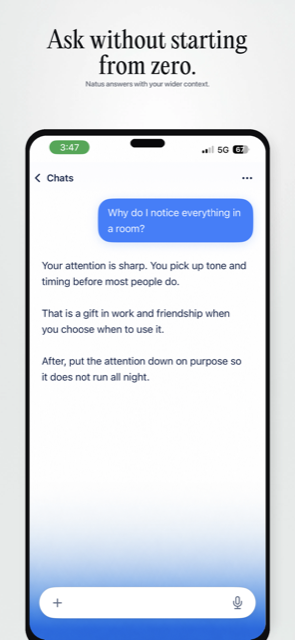
Natus is one way to keep that record. It reads your own journal entries over time and points out what keeps coming back: what you return to, what drains you, and what people keep asking you for. It is one option among several. A paper notebook works too, if you actually keep it.
What matters is that the evidence comes from your real weeks, not from a quiz or from someone else's story. Your purpose and your strengths are not assigned to you. They are already in your days, and you just need them in one place long enough to see the shape. If the shape you find is closer to what you are good at, go there next. If it is the purpose question itself, start with how to find your purpose.