What am I good at?
What am I good at is a question you can already answer from evidence you own. Your strengths show up in what people keep coming to you for.
Reading time: 7 min
You find what you are good at by noticing what people keep coming to you for, and what you keep doing when nobody is watching or paying. You are the worst witness to your own strengths, so look at the evidence, not your opinion of yourself.
Your strengths are not hidden, they are just boring to you. When something comes easily, you assume everyone can do it, so you never count it as a skill. That is the exact reason you miss your own gift.
What may be happening
If you think you have no skills, you are usually measuring against the wrong thing. You are comparing yourself to people who are famous for one ability, or to a job title, or to a test that ranked you in the middle of a long list. None of that is evidence about you.
There is a specific ache in this, and people name it well. One Reddit user described it as "I have width but no depth." Another, in a post with a few hundred upvotes behind it, put it flatly: "I have absolutely zero skills of any kind." The second one is almost never true. It is what it feels like when you are the only person who cannot see your own pattern.
The search data shows the same trap. "What am I good at" gets about 1,000 searches a month in the US and it is rising, while "what are my strengths" gets about 4,400. Even more people search the word quiz. The honest question is being asked in a place that cannot answer it.
How it tends to show up
- You can list what you do at work but not what you are naturally good at.
- You assume your best skill is nothing special, because it feels easy.
- Friends come to you for the same thing again and again, and you do not notice.
- Test results feel either obvious or wrong, and neither one changes anything.
- You can spot another person's strength in seconds and go blank on your own.
Why do tests and the passion advice never settle it?
Two pieces of popular advice fail here. The first is take a test. The second is follow your passion.
On the passion advice, people have already voted. In one long Reddit argument about whether follow your passion is bad advice, the top reply said: "What you should really follow is what you're really good at." That reply had 424 upvotes. The line defending passion had 63. The room picked the practical one by about seven to one.
That is worth sitting with. The internet has spent years telling people to chase a feeling, and the most agreed with answer in the argument was to look at ability instead. A test cannot show you ability. It can only ask you what you already think about yourself.
Passion is also a feeling, and feelings come and go with your sleep and your week. If you wait for a burning passion before you trust a skill, you will wait a long time and call yourself untalented while you do it.
Why awareness alone may not change it
Naming your strengths in one sentence does not stick, because a single sentence is easy to argue with. What sticks is a pile of small evidence you cannot dismiss. The same thing being asked of you by five different people over two years is hard to wave off.
That pile does not live in your head. Memory keeps the highlights and drops the ordinary afternoons, and your gift lives almost entirely in the ordinary afternoons. This is why the honest answer is usually sitting in a notebook you already own.
People describe their gift in exactly this way, with no help at all. Under one TikTok video, someone asking what their gift was wrote: "for some reason people always trust me with their high level secret that they cannot even share with their famz, they always find peace talking to me about it". That is a strength, described perfectly, by someone who was not sure they had one.
If work is where this bites hardest, read who you are without your job. If you can see the pattern but cannot move it, read why you are self aware but still stuck. Both are this question wearing different clothes.
A question worth carrying
What do people ask me for, even when I keep telling myself it is nothing?
How Natus approaches this
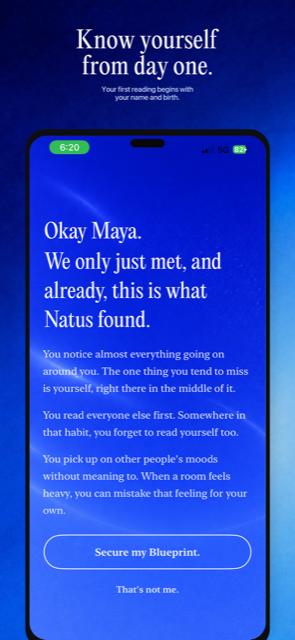
Natus is one place to gather the evidence instead of guessing. It reads your own journal entries and weeks over time and points out what keeps repeating: the thing you always help with, the thing you always notice, the thing you always quietly fix. Then you decide what that is worth.
There is no test to pass and no ranking to argue with. The pattern comes from your own days, and your own days are the one thing nobody can call generic. That is the whole difference. A quiz tells you what it thinks you are. Your own record shows what you actually did.
Purpose is the bigger question. If that is the one you are carrying, start with how to find your purpose in life. If it is about direction and work, go to what to do with your life. One small recorded next step beats a ninety question test.