I have no sense of self
Feeling like you have no sense of self often comes after years of performing for other people. The quiet, unwatched part of you never got the room to speak.
Reading time: 6 min
"I've been performing different versions of myself so long I can't tell which one is real."
You can answer questions about yourself, hold up your end of a conversation, and still feel like there is nobody in there doing it. When you say you have no sense of self, you usually mean something more specific than sad: there is no one at home to check with. Preferences arrive as guesses. Opinions feel borrowed. If someone asks what you actually like, you can answer, and the answer will be true enough, and it will not feel like you.
Here is the slightly unexpected part. Having no sense of self is rarely a report of emptiness. It is a report of privacy. The part of you that has a self has almost never been alone long enough to build one, because for most of your life there was a room to read, someone to keep comfortable, and a version of you to deliver.
What may be happening
Performing is not lying. It is the shape your self took to stay safe, or liked, or uncomplicated. You learned early that being seen meant being what the moment needed, and you got good at it. People describe you as easygoing. You are the one who fits.
The cost is quiet. A sense of self grows slowly and privately. It is the plain familiarity of your own reactions, built in unwatched minutes: what you reach for, what you avoid, what you keep coming back to. If almost every minute has an audience, real or imagined, that familiarity never gets practised. You become fluent in everyone else and a stranger to your own preferences.
There is a smaller thing worth naming too. "I have no sense of self" is often the most honest sentence a person has said about themselves in a long while, and it is usually said out loud to someone else. The part of you that can report the absence is, by definition, still there.
How it tends to show up
- You can describe yourself in roles and titles, then stall when asked what you like.
- Your preferences shift depending on who is in the room, and you notice it after, never during.
- You agree quickly, then feel flat or faintly annoyed later.
- You feel most like a person when nobody is watching, and you cannot say who that person is.
- You keep your real reactions to yourself, so they stay unconfirmed even to you.
Why awareness alone may not change it
Knowing you perform does not produce a self, because the performing has a job. It keeps connection smooth and protects you from the risk of being seen and finding out what happens next. There is nothing here to force.
A sense of self also cannot be reasoned into place. It is a felt thing, and it grows from small private data: what you actually wanted in a moment, what you said yes to out of habit, the thing you keep returning to. That data needs somewhere to exist outside your head, or it stays as thin as it is now.
This is the same pattern that shows up in feeling like a different person around different people and in feeling like you have no identity. Those pages look at the same outward attention from other angles.
A question worth carrying
What do I reach for when nobody is going to hear about it?
How Natus approaches this
Natus starts by building a Blueprint from your name and birth details, so you are not trying to meet yourself from a completely blank page. It is a reference point of your own, a shape to recognise yourself against rather than a label you have to perform.
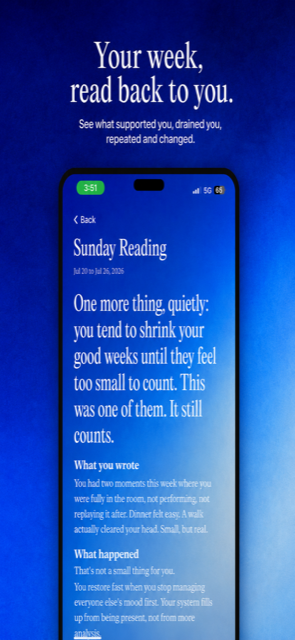
From there, it reads what you write against that Blueprint and holds your threads across weeks. Over time the unwatched version of you gets somewhere to exist, and the small private truths stop disappearing the moment the room changes.