How to stop replaying conversations in your head
Replaying conversations is your mind trying to finish something it cannot finish alone. Why the loop runs and what actually closes it.
Reading time: 6 min
"Sometimes I even repeat it out loud to myself"
If you replay conversations, you already know the loop. The meeting ends and the meeting continues. You reword what you said, supply the comeback that arrived three hours late, re-read the look on their face. Days later it can still run.
The plain answer: the replay is trying to finish something. Your mind runs the scene again because some part of it believes the conversation is not over. Maybe you came across badly. Maybe something went unsaid. Maybe you cannot tell how you landed. The loop is waiting for a resolution that thinking cannot produce. That is why it never ends on its own.
What may be happening
Replaying is self-correction running after the fact. Your mind rehearses alternate versions of the scene to fix how you came across, or to pre-load a better move for next time. It feels like problem-solving. It is not, because no new information ever arrives. You already have everything the scene contains. The hundredth viewing shows you nothing the first ninety-nine did not.
Underneath most replays is a question the loop cannot answer alone. Did I say the wrong thing? Are they angry? What do they think of me now? The mind keeps the scene open like a file it is afraid to close.
How it tends to show up
- The same scene loops for days, and each pass adds better lines you will never get to say.
- It spikes in the shower, on the drive, and especially at night when nothing else is running.
- You catch yourself mouthing the words, sometimes out loud.
- You ask friends to re-argue it with you, and their verdict holds for about an hour.
- "Overthinking without pushback is torture." The replay is a courtroom where you play every role.
Why awareness alone may not change it
Knowing you are replaying does not stop it, because the loop thinks it is still working. It is holding the file open until a verdict arrives, and a verdict cannot come from inside the loop. Only two things close a replay: an action, or an acceptance. Send the text. Ask the question. Or decide, on purpose, that the scene is allowed to stay unresolved.
The practical move is to ask the replay what it wants. What am I trying to fix or check by running this again? Then either do that thing, or write the whole loop down once in full, so the mind can trust it is captured and stop holding it. This is one lane of overthinking everything, and it loves the quiet hours, which is why it pairs with racing thoughts at night. If the replays always end with you at fault, the inner critic is running the courtroom.
A question worth carrying
What is this replay trying to get me to do, and can I just do that?
How Natus approaches this
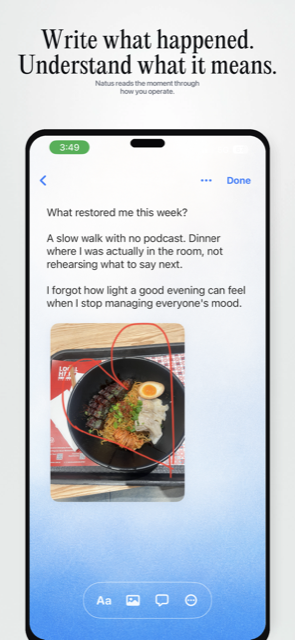
Natus gives the replay somewhere to go. You write the scene down once, and because it already knows the threads you keep circling, the pattern underneath becomes visible: the same worry wearing different conversations. It reads your week back against a personal map of how you operate, so the loop becomes something you can see from outside, not a file your mind has to hold open forever.