How do I stop comparing myself to others?
A warm, practical look at how to stop comparing yourself to others: the moments it happens, why it repeats, and how tracking your pattern can soften it.
Reading time: 6 min
You finish a normal day, open your phone, and see that someone you know got something you quietly hoped for. Or you leave coffee with a friend feeling two steps behind, even though nothing bad happened. You may be asking how to stop comparing yourself to others, because the habit feels automatic and the aftermath feels awful.
The honest answer is that you likely will not stop by telling yourself to stop. Comparison is normal. It becomes painful when it runs unexamined and turns into a verdict about your worth. What helps is specific: catch the moment, name what it touched, and give your attention a different task. Over weeks, the pattern becomes visible enough to interrupt. This page is the practical how. If you need the feeling named first, see why everyone seems better than you.
What may be happening
Comparison is not a flaw in your character. It is how the mind tries to locate you. It checks where you stand because that once mattered for belonging and safety. In small doses it can show you what you want. It turns painful when it stops being information and becomes a sentence about you.
Online life makes this harder. You see highlights and announcements without the ordinary days around them. Your real, tired, unfinished life gets measured against a version that is not the whole story. You are not weak for being affected. You are responding to incomplete evidence.
The comparison usually lands where you already feel uncertain. If you feel behind in work, every promotion stings. If you feel unsure in relationships, every couple photo can feel like proof. Underneath, it is often a question about worth, safety, or direction. It can also link to why you feel behind in life, which is less about the calendar and more about the story you tell about your pace.
Things to try: name the comparison in one plain sentence. Ask what it points at: a real desire, a value, a fear? Put a boundary on the input. Mute accounts that reliably leave you feeling small. Take one small action in your own lane within a day. Track the moment, the trigger, the feeling, and what you did next. This last part matters most. Across a week or two, you stop seeing random bad moments and start seeing a pattern.
This may also connect to feeling like you are not good enough, because comparison often borrows that older sentence. The goal is not to never feel a pang. The goal is to stop letting the pang write the whole story.
How it tends to show up
- You see a promotion, a wedding, or a trip, and your own recent wins go quiet.
- You meet friends and mentally rank your life against theirs while smiling.
- You scroll before bed, then lie awake listing what you lack.
- You finish something good, then find someone who did it earlier or better.
- You hold back good news because someone else's will seem bigger.
- You feel relief when someone else struggles, then guilt for feeling it.
- You choose based on how it will look next to someone else's life.
Why awareness alone may not change it
You can know exactly what you are doing and still do it. Comparison is a habit with a payoff. It gives you a quick sense of orientation. For a second, you know where you stand, even if the answer hurts. The mind often prefers painful certainty to an open question.
It repeats because it attaches to specific moments: the same person, the same app, the same Sunday evening. Without a record, each instance feels like a fresh emergency. With a record, you can see the loop. You notice it hits when you are tired, after speaking to one particular person, or in the gap after a project ends. That detail makes a different response possible.
Instead of trying to stop all comparison, work with one recurring moment. Plan for it. Decide in advance what you will do when it arrives. You may still feel the pull, but you are not starting from zero. The page on how to stop beating yourself up can support this, because harsh self-talk often keeps comparison burning. And if you are unsure of your own strengths, discovering them gives you something sturdier to measure against: your own earlier self.
A question worth carrying
What if the point is not to win the comparison, but to notice the moment you leave your own life to stand in someone else's?
What would you do differently today if you trusted that your path does not need to be measured against anyone else's?
How Natus approaches this
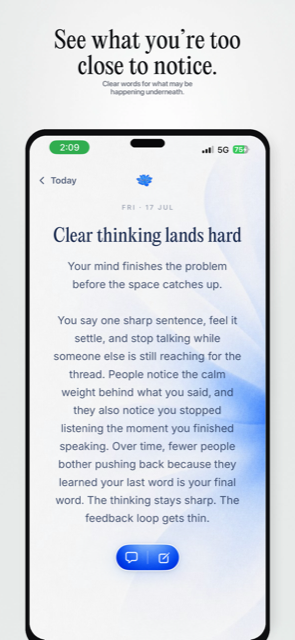
Natus is an iPhone self-discovery companion. It starts with a personal reading from your name and birth details, then offers a daily insight and a diary you can talk to. It remembers what you write and reflects your patterns back to you. It does not predict the future and it is not therapy. For comparison, that matters because the pattern is often invisible in the moment but clear across weeks.
Over time, Natus can show you when the same trigger keeps returning, what you wrote right before it, and how you spoke to yourself afterward. Seeing that does not magically remove the feeling. It gives you a place to stand. You can meet the moment with more honesty, less shame, and a small response that belongs to your life.