Why do I feel behind in life?
Feeling behind in life often comes from measuring your private process against someone else's visible milestones and an inherited timeline.
Reading time: 6 min
Feeling behind in life can make an ordinary day feel like evidence against you. Someone gets promoted, engaged, married, settled, published, or further ahead financially, and a quiet voice says you should be there too.
That feeling is real. But it is not always telling the truth about your life. Often, it comes from measuring your private process against other people's visible milestones, then treating a borrowed timeline as if it were a fact about who you are.
What may be happening
You may be carrying a picture of where you were supposed to be by now. Some of that picture came from family. Some came from school, culture, friends, social media, or the age when certain milestones were presented as proof that a person was doing well.
The timeline can become so familiar that you stop noticing it is only one version of a life. You see the next job, the home, the relationship, the savings, or the clear direction, and you read your distance from that picture as failure. But a timeline measures pace, not meaning. It cannot tell you whether the path fits you, whether the choice is yours, or what it took to get where you are.
Feeling behind can also appear when an old plan stops making sense. You may have spent years following what seemed sensible, then reached a point where the reward no longer feels like yours. That pause can look like delay from the outside, even when you are trying to build a life that fits more honestly.
How it tends to show up
- You compare your age with other people's milestones and feel a drop in your stomach.
- Good news about someone else quickly becomes a question about what is wrong with you.
- You hide parts of your life because they do not match the version you think you should present.
- You rush into decisions because being in motion feels better than feeling late.
- You dismiss progress unless it looks impressive to someone else.
- You feel pressure to choose a direction before you know whether you actually want it.
The comparison is rarely balanced. You see their result and your uncertainty. You see their announcement and the weeks you spent doubting yourself. That is the same unfair comparison behind feeling like everyone is better than you, where your inside is placed next to everyone else's outside.
Why awareness alone may not change it
You can know that comparison is unhelpful and still feel behind the next time someone shares good news. That is because the feeling is not only an idea. It can be tied to belonging, approval, safety, and the fear that time is closing around you.
A list of achievements may not settle it either. If the rule is always the next milestone, reaching one goal only moves the finish line. You may get what you thought would finally make you feel on track, then discover that the measuring voice has already found a new way to mark you as late.
What changes the question is not forcing yourself to feel grateful or pretending milestones do not matter. It is asking whose definition of progress you have been using. A direction becomes more trustworthy when it comes from what is steady and true in you, not only from what will look convincing from a distance.
That is why feeling behind can sit beside feeling lost in life or the uncertainty of a quarter-life crisis. The issue may not be that you are late. You may be between one set of expectations and a life you have not named yet.
A question worth carrying
If nobody could compare my life with theirs, what would I decide matters now?
How Natus approaches this
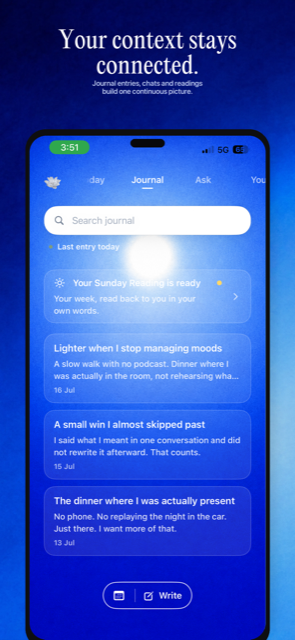
Natus gives you a personal reference point, so your life does not have to be measured only against public milestones. It starts with how you tend to operate, then helps you notice what keeps returning in your real experience. That makes room for a direction that feels like yours, rather than another race you never chose.