How Do I Discover My Strengths?
How to discover your strengths using three sources of evidence: what people thank you for, what you envy, and what gives you energy. Plus a one week log.
Reading time: 6 min
You discover your strengths with evidence, not with self flattery. Three sources tell the truth better than your own opinion does: what people keep thanking you for, what you quietly envy in others, and what gives you energy instead of draining it. Where two or three of those overlap, you are close to a real strength, though it rarely feels special from the inside.
What may be happening
Most people go looking for strengths in the wrong place, which is their own head. You run through a list, feel like a fraud, and stop. The problem is not modesty. It is that your strengths are the things you do so automatically that they leave no impression, so there is nothing for you to recall.
There is also a definition problem. We use one word, strengths, for two different things. A natural strength is what you are disposed to do well. A skill is what you have trained. You can be strong at something untrained, and skilled at something that never stops feeling like effort. Mixing the two makes the whole exercise muddy, because you end up listing what you are practised at, and missing what you are built for.
How it tends to show up
Three evidence sources, and you should trust them more than your own gut.
- Feedback. What people repeatedly thank you for or come to you about. Not one compliment, the pattern across several people.
- Envy. What you feel a small, specific envy toward when you see someone doing it. Envy is often a strength you have not given yourself permission to use.
- Energy. What leaves you fuller rather than emptier. Attention that returns is a strong signal that a strength is in play.
Where two or three of these point at the same thing, write it down. That overlap is your evidence, and it is far more reliable than the list you would produce alone.
Why awareness alone may not change it
A named strength is not a used strength. You can know you are good at holding people steady and never once arrange your life around it. Awareness becomes useful only when it changes a decision, even a small one, like taking the task that leans on the strength instead of the one that fights it.
The other limit is that evidence from your own head is unreliable. This is why feeling like everyone is better than you is so common even in capable people: you are comparing your unseen effort to other people's visible results. A strength only becomes trustworthy when it is written down and checked over time. That is the same reason understanding yourself needs something to compare against.
A question worth carrying
Which of my strengths would I trust a stranger to see, if they watched my behaviour rather than listened to what I say?
Run a one week noticing log. Each evening, write a single line: a moment you felt able, a moment you felt drained, and one thing someone thanked you for. That is all. Seven lines. At the end of the week, read them together and circle whatever repeats. Repetition across a real week is the closest thing to proof you will get about your strengths.
How Natus approaches this
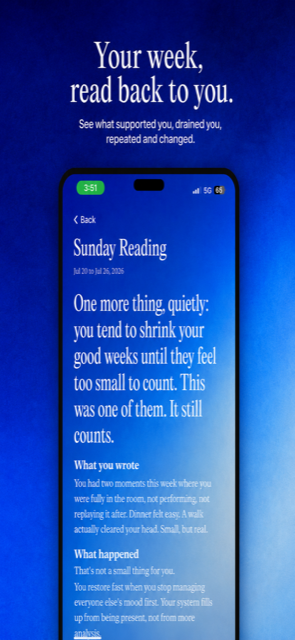
Natus starts from the strengths side by design. It builds a personal blueprint from your name and birth details, then reads what you write against it, so your natural lean shows up next to the evidence of your own days.
The one week log above is the kind of thing Natus keeps for you automatically, which is what turns a short list into a living picture you can trust. If you want a quick first read, the what am I good at quiz names your strongest natural ability in about a minute. Or start finding your strengths and get your first reading free.
Common questions
- How do I discover my strengths?
- Use three sources of evidence instead of your own opinion: what people thank you for, what you quietly envy in others, and what gives you energy rather than draining it. Where two or three of those agree, you have found a real strength rather than a wish.
- What is the difference between a strength and a skill?
- A skill is learned and can be measured against a standard. A strength is a natural lean that a skill sharpens. You can be strong at something you never trained and skilled at something that always feels like effort, and knowing which is which tells you where to invest.
- Why is it hard to see my own strengths?
- Because strengths feel normal from the inside. If it comes easily to you, you assume it comes easily to everyone, so you never list it. Other people and your own energy are better witnesses than your self image.