How to stop catastrophizing
Catastrophizing is your mind skipping every middle option and landing on the worst one. Why it does that, and what actually loosens it.
Reading time: 6 min
"My brain goes to the immediate worst outcome."
If that is you, you already know the jump. A text sits unanswered and within seconds it is a rejection. A tight chest is a diagnosis. A short reply from your boss is the first scene of you getting fired. The middle options never get a hearing.
The honest answer to stopping it is not what you have been told. You do not beat catastrophizing by arguing with the thought, because the thought is not a prediction. It is a preparation. And you cannot out-argue a mind that thinks it is getting you ready.
What may be happening
Somewhere along the way, your mind learned that picturing the disaster first is safer than being surprised by it. If you imagine the worst before it arrives, it cannot blindside you. You will have already felt it. You will have a plan.
That is the whole trick. Catastrophizing is a safety habit. It treats rehearsal as protection. The problem is the rehearsal never ends, because there is always a worse version one step further out. So the jump keeps firing, and each jump costs you a real feeling about an event that has not happened.
You end up living through disasters on a loop while nothing is actually wrong. That is exhausting in a way that is hard to explain to people whose minds do not do this.
How it tends to show up
- One small thing becomes a whole future in seconds. A delayed reply is the end of the friendship.
- You feel the fear of the imagined outcome as if it already happened. Your body does not know the difference.
- Reassurance works for a few minutes, then the mind finds a new worst case.
- You have plans for emergencies that never come, and the planning feels responsible.
- You call it being realistic, or prepared, or just how you are.
Why awareness alone may not change it
You may already know you catastrophize. You may catch the jump mid-flight and still watch it land. Knowing does not stop it, because the jump is doing a job. It believes that if it stops scanning for disaster, you will be caught off guard by something you could have seen coming. As long as being unprepared feels dangerous, the mind keeps the habit.
This is also why "that probably will not happen" does not work. The mind is not asking about probability. It is asking about readiness. The useful shift is smaller than stopping: notice the jump as a jump, while it is happening, and get curious about what it is trying to protect you from. A mind that jumps to the worst outcome is usually carrying constant worrying underneath it, and it runs on the same fuel as overthinking everything, where the loop itself is the safety mechanism.
A question worth carrying
What is this worst case trying to make sure I am ready for?
How Natus approaches this
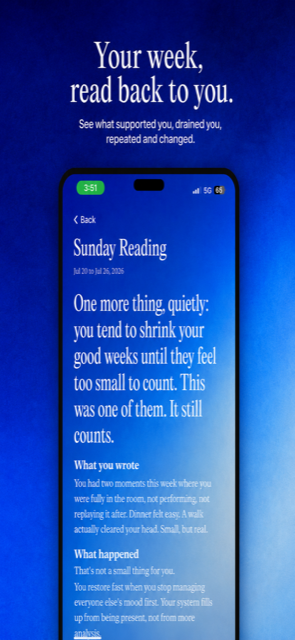
Natus starts with a personal map of how you operate, so the jump to the worst outcome becomes something you can see from a step back, in real time, instead of something that takes the whole evening. It reads your week back against that map, so you start to notice where your mind always lands first. Not a promise the jumping stops. A place to stand where you can finally watch it happen.