What Am I Naturally Good At?
Natural strengths hide in what feels easy, because easy feels like nothing. Three blind spots that keep you from seeing what you are naturally good at.
Reading time: 6 min
You are naturally good at the things that feel like nothing, and that is the whole problem. Because a natural strength costs you no effort, it never registers as a strength, so you leave it off the list and chase the harder, more impressive things. The answer is usually sitting in the last few things people thanked you for.
What may be happening
Natural strengths are invisible for three reasons, and all three are habits rather than facts.
- You discount what is easy. If it does not feel like work, you assume it does not count. You compare it to the hard things you fought for and decide the easy one is not real.
- You compare your inside to other people's outside. From the inside you see all your doubt and fumbling. From the outside you see their finished effort, so you assume they are naturally better than you at everything.
- You only notice what you were praised for. Childhood praise usually went to visible achievements, so your quiet strengths never got a mention, and you learned to call them normal.
How it tends to show up
The clues are behavioural, not felt. You can find them without trusting your own self-image.
- What is easy on the first try. You pick something up fast, or you were doing it well early, before you had properly learned it.
- What people keep asking for. The friend who always calls you to untangle a situation. The colleague who checks their wording with you.
- What you notice that others miss. A detail, a tone, a risk. Your attention goes there for a reason.
- What you would teach without notes. The thing you could explain for an hour without preparing. Fluency is a map of natural ground.
Why awareness alone may not change it
Knowing what you are naturally good at does not change your choices until you start treating it as real. The usual failure is that you name a strength, decide it is not special, and go back to fighting the thing you are less suited to. The list did nothing because you never acted on it.
The other reason awareness stalls is that a generic description is forgettable. If a test or a person tells you that you are "empathetic and creative", it slides off, because it could describe anyone and never points at your actual behaviour. A strength becomes usable when you can see it in specific moments you remember. That is why readings that fit everyone leave no trace, and why feeling like everyone is better than you so often sits on top of an unnoticed strength.
A question worth carrying
If a stranger watched me for a week and could not see my doubt, what would they assume I was naturally good at?
Try the one question method. Ask three people you trust: "What do you think comes naturally to me?" Give them the real question, not a compliment request, and write the answers down word for word. Compare them with your own guess. Where all three agree, and disagree with your guess, is worth your attention.
How Natus approaches this
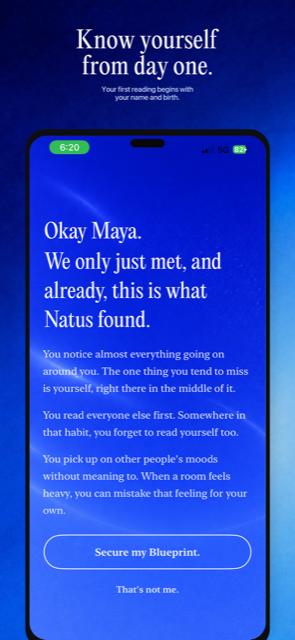
Natus is built around exactly this question. It starts with a personal blueprint generated from your name and birth details, so it can point at the strengths that come naturally to you before you have proven them to anyone.
From there it reads what you write against that blueprint, which turns a vague sense of what you are good at into specific things showing up in your own weeks. If you would rather test it yourself first, the what am I good at quiz names your strongest natural ability in about a minute. Or see what you are naturally good at and get your first reading free.
Common questions
- How do I know what I am naturally good at?
- Look at what you do well on the first try, with no particular build up, and what people keep coming to you for. Natural strengths feel effortless from the inside, so your own sense of ease is a weaker signal than other people's repeated requests.
- How do I tell natural from practised?
- Practised things show up as smooth and polished. Natural things show up as quick and unforced, often before you have learned them properly. If you were doing it well early, with little effort, it is closer to natural than learned.
- Can I be good at something and not enjoy it?
- Yes, and often. Skill and enjoyment are separate. Plenty of people are naturally good at something they do not like, and enjoy something they find hard. Both facts are worth knowing, because they point in different directions.