Why do I self sabotage?
Self sabotage often protects something quiet, even when it costs you what you wanted. The move makes sense from the inside.
Reading time: 6 min
Self sabotage is not a lack of wanting. It is often a way of protecting something quieter than the goal you can name, and it tends to fire hardest right when success becomes possible.
What may be happening
From the outside, self sabotage looks like getting in your own way. You land the job and stop preparing. You meet someone good and pick a fight. You reach the last chapter and abandon the book. People call it fear of success, or fear of failure, or laziness. Those labels usually miss the job the move is doing.
The move is doing protection.
If a part of you learned, early, that visible effort carries risk, then stopping just before the result can feel safer than finishing. As long as you never fully tried, failure keeps an excuse: it was not really a test. As long as you pull away before closeness lands, you never have to be seen at your most hopeful. Self sabotage often protects a smaller, older version of you that decided not wanting too much was the way to stay safe.
The cost is that you get to be right about the pattern, and wrong about the good thing.
How it tends to show up
- You start strong, then stall once the outcome is genuinely close.
- You make a small careless mistake at the exact moment things start going well.
- You pick a fight or find a flaw right after an intimate conversation.
- You oversleep, "forget," or half-do the task that matters most.
- You tell yourself you will try properly next time, and treat this round as practice.
Why awareness alone may not change it
You can know the word "self sabotage" and still do it, because the behaviour is earning something. Naming it ("I ruined it again") describes the result without answering what the move was for.
Often it is for control. The unpredictable part of success, closeness, or completion is that other people and outcomes get a vote. Sabotage returns the vote to you. If you ruin it, you are the author of the ending, even when the ending is painful. Pain you choose can feel more survivable than hope you cannot guarantee.
Awareness becomes useful when it stops being an apology and becomes a question: what would finishing, or staying, or being seen actually require from me? The answer is usually the thing being avoided.
This page is not a prediction or a diagnosis. It is a clearer frame for a pattern that is often mistaken for weakness but is usually a strategy.
It often runs alongside keeping choosing the same type of person when the risk is closeness, or starting over instead of continuing when the risk is finishing something imperfect. It can also look like being self aware and still stuck, where you can name the whole loop and still live inside it.
A question worth carrying
What would I lose control of, if this actually worked?
How Natus approaches this
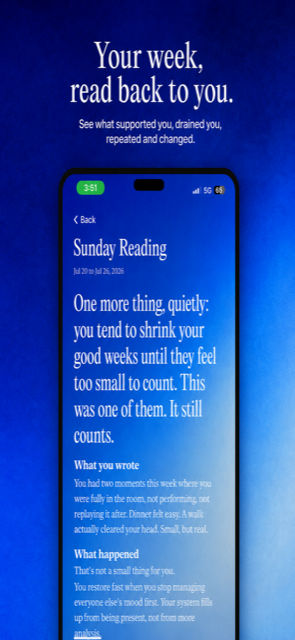
Natus does not hand you a list of habits to fix. It starts with a personal map of how you operate, then meets what you write against that map, so a pattern like self sabotage becomes recognisable in the moment instead of a thing you only notice after the damage. The aim is recognition, not homework or a label.