Why do I pull away when someone gets close?
Closeness can expose needs, uncertainty, and loss of control. Distance may become the fastest way to feel steady again.
Reading time: 6 min
You pull away when someone gets close because closeness can raise needs, uncertainty, and a sense that you are no longer fully in control of your own pace. Distance often restores a feeling of solid ground.
What may be happening
From the outside, pulling away can look like mixed signals or low interest. From the inside, it can feel like oxygen.
At a distance, you can choose when to engage. You can edit. You can keep your longing private. You can stay the version of yourself that seems composed.
When someone moves nearer (more consistency, more warmth, more expectation of presence), the terms change. You may start to feel watched by the relationship itself. Small delays get heavier. Ordinary needs get louder. The possibility of disappointing them, or needing them, becomes harder to ignore.
So the system reaches for a familiar fix: create space. Become busy. Get quieter. Find a flaw. Start an argument about something small. Romanticise independence. Call it “needing time” without naming what the closeness stirred.
The point is not that you do not want connection. Many people who pull away want it deeply. The trouble is that closeness can feel like exposure before it feels like rest.
How it tends to show up
- You feel most interested when the other person is slightly out of reach, then cooler when they become available.
- After a tender conversation, you go quiet for days and cannot fully explain why.
- You notice yourself picking at their habits once things feel secure.
- You want reassurance, then feel crowded the moment it arrives.
- You tell yourself you are protecting them from the messier parts of you, while mostly protecting your own equilibrium.
Why awareness alone may not change it
You may already know the pattern. You may even warn people: “I pull away.” Naming it does not always slow the move, because the move is doing work.
That work is often a bid for steadiness. Closeness introduces variables you cannot fully script: their mood, their needs, their opinion of you over time, your own desire to stay. Distance reduces variables. Reduced variables feel like safety.
So the deeper logic may be: if I stay close, I will need, hope, or be seen in ways I cannot control. If I step back, I return to a self I know how to manage.
Awareness of the behaviour (“I ghosted after a good weekend”) is useful. Recognition of the personal logic (“goodness raised the cost of losing this”) is what makes the pattern less automatic.
This page is not a prediction about your relationships, and it is not a set of instructions for how to stay. It is a clearer frame for a move many people make while still caring.
It often travels with choosing the same type of person: chase the almost-available shape, then step back when someone becomes near. The same protective logic can look like over-explaining when you stay, or like being self-aware and still stuck when you can name the whole dance.
A question worth carrying
What does closeness take from you that distance quietly gives back?
How Natus approaches this
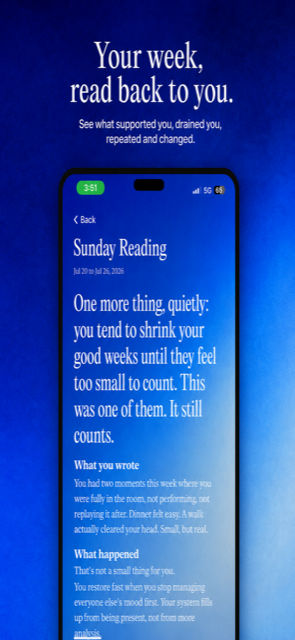
Natus begins with a personal map already in place, so you are not left alone to invent why this keeps happening from a blank page. It is built for recognition of how you operate under closeness, not for relationship homework or clinical labels.