What is a multipotentialite?
A multipotentialite is someone with many real interests and no single calling. Here is what the word means, who it fits, and the honest downside nobody mentions.
Reading time: 6 min
A multipotentialite is a person with many genuine interests and abilities rather than one clear calling. The word was popularised to describe people who feel drawn to several unrelated fields at once, and who do not fit the specialist story of picking one thing and doing it for thirty years.
If that sounds like you, the label can be a relief. It is also not the end of the answer. Knowing you have a name does not tell you what to do with your Tuesday, and there is a cost to this shape of person that is usually left out of the celebration.
What may be happening
The term comes from the idea of someone whose interests span more than one field, strongly and sincerely. It is not a diagnosis and it is not a formal category you can be tested for. It is a description that happens to fit a lot of people who have been told, for years, that they just need to focus.
Two different things get folded into the word. The first is real breadth, where several interests each get real effort and real time. The second is restlessness, where new things feel exciting and old things feel heavy, and the interest moves on before any depth arrives. From the inside they can feel identical. From the outside, only one of them leaves a trail of finished work.
That distinction matters, because the advice is different for each. Breadth needs structure. Restlessness usually needs something to hold onto when the interesting part ends.
There is a third pattern worth ruling out, and it is the reason some people bounce off the word. Sometimes many interests are not breadth at all but a way of staying busy enough to avoid one uncomfortable question. That is not a character flaw, and it is not laziness. It is worth being honest about, because a label that explains everything can also excuse anything.
How it tends to show up
- You have two or three interests that feel equally serious, not like hobbies.
- You are good at the beginning of things and less practised at the long middle.
- Picking one path feels like losing the others, not like choosing.
- You have been told to focus so many times that you now say it to yourself, and it still does not work.
- You do well when a project needs several kinds of thinking at once.
- You are bored by roles where the work is the same shape every day.
Why awareness alone may not change it
Finding the word is a genuine moment. It explains a pattern that used to look like a defect. Awarding yourself the label does not change the practical problem, which is that jobs, courses and relationships are mostly built around one specialisation at a time, and you still have to decide what to do next.
There is also a trap in the label itself. If multipotentialite becomes an identity you defend, then every new interest is proof of who you are, and the question of what you are building gets postponed again. The word is meant to free you from the wrong story, not to replace it with a nicer one that also avoids the work.
What actually moves things is seeing your own evidence: which interests have survived contact with difficulty, and which keep coming back after you have lost interest in everything else.
That evidence takes a little time to gather, and it needs somewhere to sit. Most people try to remember it, then rely on memory, then conclude they have no pattern at all. The pattern is real. It just does not live in your head, because your head keeps the dramatic days and drops the ordinary ones.
A question worth carrying
Which of my interests has survived a boring stretch, and what did that tell me?
How Natus approaches this
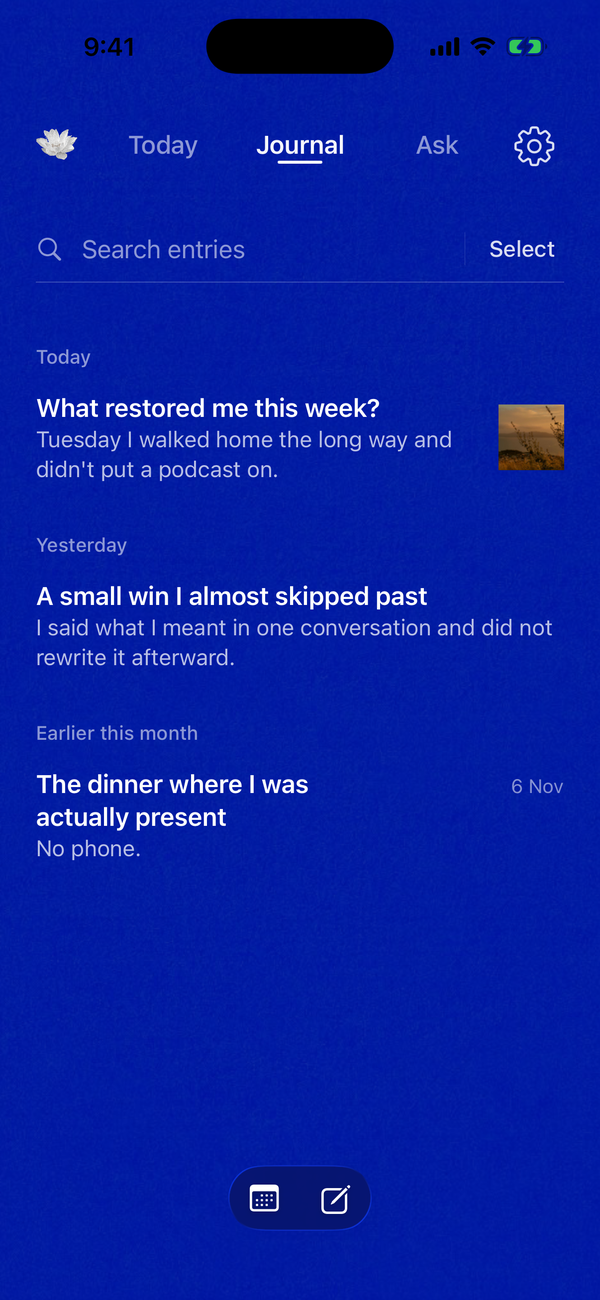
Natus is not a test for multipotentiality, and it will not hand you a type. It starts with a personal map built from your name and birth details, then you write in it, and it reads your own weeks back to you.
For someone with genuine breadth, that turns a scattered feeling into something you can look at. Over time you start to see which interests keep reappearing, which ones you keep using to help other people, and which ones were only ever a good week. You are not asked to cut yourself down to one lane. You are shown the shape you already have, so the next choice comes from evidence instead of from another fresh start.
If the phrase itself is what brought you here, read good at everything, master of nothing. If you want the practical version of this question, read what you are actually good at.
See what you're naturally good at. Get your First Reading.