Why do I get intrusive thoughts at night
Intrusive thoughts at night are what a tired mind does when nothing is holding its attention. Why the worst thought is the one that stays, and what actually helps.
Reading time: 6 min
"And then it hits u at night again"
If that is you, the day was probably fine. You were fine. Then you are lying in the dark and a thought arrives that you did not ask for and would never choose. Something embarrassing, something frightening, something about a person you love. There was no build-up and no trigger you can point to. It is suddenly there, and it feels like it must mean something about you.
Here is the plain part. An unwanted thought at night is not a report on who you are. It is what a tired mind does when nothing is holding its attention. The thought is loud, and loud is not the same as true. Nothing about it was chosen, and nothing about it needs solving tonight.
What may be happening
During the day your attention has somewhere to be. At night the input stops and your mind is left with no task, so it starts offering material to keep itself occupied. Some of that material is the most alarming thing it can find, because an alarming thought is guaranteed to hold your attention. Nothing was happening to prompt it.
A mind with nothing to do will take the strongest signal it can generate, and the thought that shocks you is the strongest one available at 2am. That is why the ugliest thought is usually the one that stays, and why the thought you would least want to have is the one that comes back. There is no useful information in the shock. A thought that disturbs you is doing its job, which is to be impossible to ignore.
How it tends to show up
- A thought arrives that you would never say out loud and never chose to think.
- You lie still and try not to think it, which keeps it exactly where it is.
- You start wondering what it says about you that your mind went there at all.
- The same thought is quieter in daylight and faintly ridiculous by breakfast.
- You go over it in the morning to work out whether it says something about you.
- You wake up tired from a fight nobody else saw.
Why awareness alone may not change it
Knowing that thoughts are just thoughts is true, and it rarely helps at night, because at 2am the thought has your full attention and no competition. It echoes, because you are the only audience. Pushing it away gives it a job, and anything with a job keeps turning up for work.
Lying there trying to argue the thought down is the part that keeps you awake, because arguing is attention, and attention is the food it came for. What helps is giving the thought somewhere to go that is not a fight. Writing it down plainly, without arguing with it, takes it out of the room and puts it somewhere you can look at later. Night thoughts usually belong to the same family as racing thoughts at night, and the scanning underneath them sits close to constant worrying, where the mind keeps watch because standing down feels unsafe.
A question worth carrying
If this thought is not mine to solve, what has it been keeping me company for?
How Natus approaches this
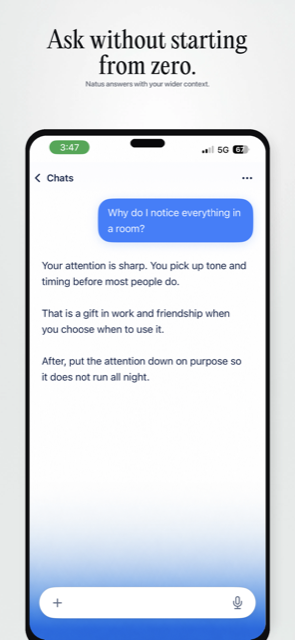
Natus gives the night something to do that is not arguing. You write or say the thought plainly, and because it already holds a personal map built from your name and birth details, it can read what you wrote against your own patterns instead of treating the thought as a surprise.
Over a few weeks you can see which thoughts arrive at night and which arrive in daylight, and what tends to be going on in your week when they do. Not a promise the thoughts stop. Somewhere to put them, so they stop being the only thing in the room.