Reflectly vs Natus: a prettier check-in or a journal that reads back
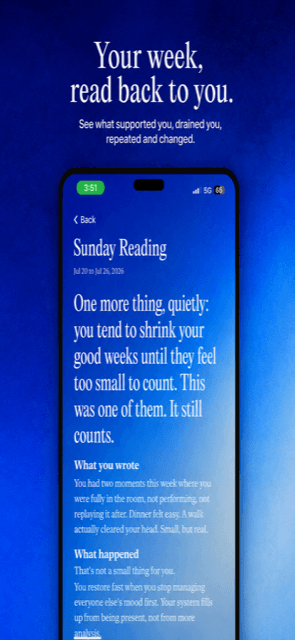
Reflectly vs Natus is a choice between a quick mood check-in and a journal that reads back. Reflectly is lighter and faster: daily prompts, mood tracking and quotes you can glance at in a minute. Natus is deeper: a First Reading built from your details, a private journal, and every Sunday your actual week read back in your own words. If you want a thirty-second daily ritual, Reflectly fits. If you want to understand why your weeks keep repeating, that is what Natus is for.
What Reflectly users say in their own reviews
Verbatim from public 1 and 2 star App Store reviews.
Erased2 star review
Journaled almost daily for two years and it logged me out and wont let me sign back in so i js lost everything
No Support1 star review
Purchased the lifetime premium membership however was not granted access to premium features. I reached out to Reflectly using both emails because there is no live chat assistance and I have received no response from the company regarding this issue.
can't restore purchase2 star review
bought lifetime in August 2024, been less than a year and now i can't restore my purchase.
Doesnt keep data1 star review
Purchased for the tracking chart. Loses data fast. Inaccurate.
Side by side
| Feature | Reflectly | Natus |
|---|---|---|
| What it is | A daily mood check-in with prompts, quotes and streaks. | A private journal plus a reading of who you are, built from your details. |
| What a session looks like | Answer a prompt, log a mood, read a quote, done in a minute. | Write what happened, ask what you need, get your week read back on Sunday. |
| What you get back | A mood chart and daily encouragement. | A read-back that names what your week kept circling, against how you operate. |
| Where it wins | Faster, lighter, nicer daily ritual. Lower commitment by design. | Slower and deeper. Built to explain patterns, not just log them. |
| The common complaint | Lost entries after logouts, and paid upgrades that never activate. | It is new, iPhone only, and asks for real writing. |
| Who it fits | People who want a gentle daily habit without depth. | People who journal because something keeps repeating and they want to see it. |
Where Reflectly still wins
It is the lower-friction habit. A mood, a prompt, a quote, and you are done. For someone building a journaling streak from zero, that ease is real, and the design is genuinely pretty.
Where people get burned
Two patterns dominate the bad reviews. First, data: users describe losing years of entries to a logout or sync failure. Second, billing: paid and lifetime upgrades that never activate, with support unreachable. Both are the kind of failure that makes someone quit journaling entirely.
Where Natus is different
Natus is not a check-in. It starts from a reading of how you operate, keeps your journal in the same context, and every Sunday reads the week back so the pattern becomes visible. It costs more attention than Reflectly and returns more than a mood chart.
Common questions
- Is Reflectly safe for keeping a long-term journal?
- The reviews give reason for caution: users describe being logged out and losing two years of entries, and mood data that disappears. If you use it, export regularly. Whatever journal you choose, periodic export is the habit that protects you.
- Is Natus a mood tracker like Reflectly?
- No. Reflectly logs how you felt; Natus is built to explain why the same feelings keep arriving. Your journal is the input and the Sunday read-back is the output.
- Which is better if I struggle to write?
- Reflectly, honestly. Its prompt-and-mood format asks almost nothing of you. Natus rewards people willing to write a few honest sentences, and pays it back with a read-back that actually knows the context.