How do I set boundaries?
A warm, practical look at how to set boundaries: noticing the pattern, the guilt, and the exact moments where a limit could protect your energy.
Reading time: 6 min
You are in a conversation, and you can feel the yes forming in your mouth before you have decided anything. Someone asks for your time, your help, your patience, and the cost is clear only after you have already agreed. You tell yourself it is fine, then lie awake replaying it, wondering how to set boundaries without becoming someone you do not recognise.
Here is the short answer on how to set boundaries. Start with a simple correction: a boundary is not a demand that someone else change. It is a statement about what you will do, what you can offer, and what you need to protect. You do not have to become colder or more difficult. You only have to become clearer with yourself first.
What may be happening
Most people who struggle here are not selfish or weak. They are often kind, tuned in, and quick to feel what others need. The problem is that this skill got turned into a duty. Saying yes felt like keeping the peace. Saying no felt like risking love, approval, or belonging.
Boundaries can feel dangerous because they touch an old bargain: if I am easy to be around, I will be kept. If I have needs, I will be too much. That bargain often comes from families or early relationships where your needs were treated as inconvenient. The pattern made sense once. It may not fit your life now.
If you have spent years trying to stop people pleasing, the reflex to say yes can feel like your personality. It is not. It is a habit with a history.
A few things to try
Start with the signal, not the speech. Resentment, dread, and a tight chest before a yes are clues that a limit is missing. Name the limit quietly to yourself: I cannot take on another evening task this week. I need twenty minutes before I answer. I will not discuss this topic today.
Then practice short sentences. A boundary does not need a paragraph or a full case for why you are right. The shorter it is, the easier it is to hold, especially while the guilt is still loud.
A few you can borrow:
- "I can't take that on this week."
- "Let me check and get back to you tomorrow."
- "I'm not going to talk about this today. I'm happy to talk about something else."
Expect the pull to explain. Many people rush into reasons because silence feels like conflict. You can notice that pull and still keep the sentence small. If you tend to over-explain yourself, treat the extra words as a signal that you are asking for permission you do not need.
How it tends to show up
- You say yes instantly, then feel heavy or annoyed later.
- You agree to a plan and spend the whole day wishing you could cancel.
- You answer messages at midnight because leaving them unread feels rude.
- You share private details with someone because the pause felt too awkward.
- You take on a task that belongs to someone else because it is easier than watching them struggle.
- You feel guilty before you have even said no.
- You snap at someone after weeks of giving more than you had.
Why awareness alone may not change it
You may know all of this. You may have read the books, saved the posts, and promised yourself you would stop. Then the moment comes and the old reflex moves faster than your intention.
Awareness helps, but it is not the same as having a new response ready. The pattern repeats because it is tied to a feeling, not a fact. When someone asks, your body may register a small threat: they will be upset, they will pull away, I will be alone. A boundary asks you to tolerate that discomfort for a few minutes instead of avoiding it. That is why it is a practice, not a decision.
It also repeats because boundaries are not just about other people. They are about the beliefs underneath. If you believe your worth depends on being available, every limit feels like proof that you are failing. If you believe rest must be earned, then rest becomes a negotiation. These beliefs can keep you stuck even when you can explain boundaries perfectly. You may see this with feeling guilty when you rest, or with losing yourself in a relationship, where your needs became background noise.
A boundary can also stir the fear of being pushed away, or the urge to push people away before they can leave. The same protective pattern can wear different faces. Seeing it across weeks, not just in one hard moment, is what shows you the shape.
A question worth carrying
What if the people who matter can handle an honest no, and the ones who cannot were never holding you safely to begin with?
How Natus approaches this
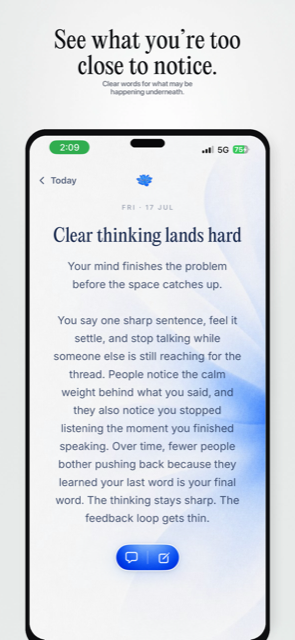
Natus is an iPhone self-discovery companion. It starts with a personal reading from your name and birth details, then gives you a daily insight and a diary you can talk to. It does not predict the future and it is not therapy. It reads what you write, names patterns it notices, and remembers them so you can see how a boundary moment connects to last week, last month, and the same feeling you have met before.
When you write about a yes that cost you, Natus can show that moment beside earlier ones. You may notice that the guilt arrives before the ask, or that the same person brings the same tight feeling. That kind of seeing is quiet, but it changes what you can do next time. Not because you are told to be firmer, but because you start to recognise the moment before you abandon yourself.