What is the best free career test for adults?
Free career tests are easy to find and easy to misread. What the good ones actually measure, how to spot a weak one in two minutes, and the evidence adults already have.
Reading time: 7 min
Free career tests are everywhere, which is both the good news and the problem. The good ones give you language for work you had not considered. The weak ones give you a confident list of jobs based on almost nothing, and adults tend to trust them more than they should because the result arrived in a serious font.
Here is the useful frame. A free career test measures interest and preference. It does not measure ability, and it cannot see your life. Your work history, your money, your health, your family and your age are all outside the questionnaire, and all of them matter more than the result.
What may be happening
You are probably asking one of three questions. What work would suit me better than this. What am I actually suited to. Or, am I wasting something by staying where I am.
A test answers a narrower version of all three. It compares your answers to a library of job descriptions or to other people, then hands you a shortlist.
That is genuinely worth twenty minutes, for one reason: naming. Most people who feel stuck are not short of options. They are short of vocabulary for the kind of work that would fit. A test can hand you three words you did not have, and one of them might land.
What it cannot do is decide. It does not know that you have a mortgage, that you are good under pressure only when the stakes are real, that you have already tried a version of that job and hated the commute, or that you are the person everyone brings their mess to at your current work, which is a skill even though it is not in your job title.
How it tends to show up
The usual sequence goes like this.
You take a free test at 11pm, get a shortlist, and one item on it feels unexpectedly right. You take a second free test the next night and get a different shortlist. Now you have two lists and less clarity than before, so you take a third. You send a result to a friend, who says that does not sound like you at all.
Then the honest part. You notice the free tests that asked about your interests gave you a different answer from the free tests that asked about your personality. You notice the one that felt most accurate was also the shortest. And you notice that none of them asked the question you actually care about, which is not what job suits me, but what would I still do on a bad week.
There is a specific adult version of this. You have a work history now, which means you are sitting on evidence no quiz can see. The tasks people keep asking you to do. The thing you fixed that nobody else wanted to touch. The part of the job you would do for free. The part that takes you two hours and drains the rest of the day.
Why awareness alone may not change it
A shortlist is not a decision, and a decision is not a plan.
The first limit is the measurement. Most free tests score interest, not ability, and the two are not the same. You can be interested in work you would be slow at, and good at work that bores you until you get deep enough to see the interesting part.
The second is the free part. Many free tests exist to collect an email or to sell a longer report. That does not make them dishonest, but it does mean the short result is a sample. Read the free result as a prompt, not a verdict.
The third is the missing context. No questionnaire knows your constraints, and constraints decide most real career moves. Which is why the better question is not what suits me, but what suits me now, given what I have and what I will not give up.
That is also why two tests disagreeing is not a failure. Where they disagree, you have found the edge of your own fit, and the edge is more useful than the centre. If you want the mechanics of why, what a career quiz can and cannot tell you covers it in more detail.
A question worth carrying
What have I been asked to do more than once, by different people, without being asked to?
That question is doing the job the test claims to do. Answer it in writing, with three specific examples, and the pattern is usually visible within a page. Then test it: is there work where that thing is the main event rather than a side task? That is a direction, and it came from your record rather than a quiz.
For one week, add one line a day about the moment work felt easiest. Not the most impressive. The easiest. Adults usually find the same two or three activities appear, and none of them were on the shortlist.
How Natus approaches this
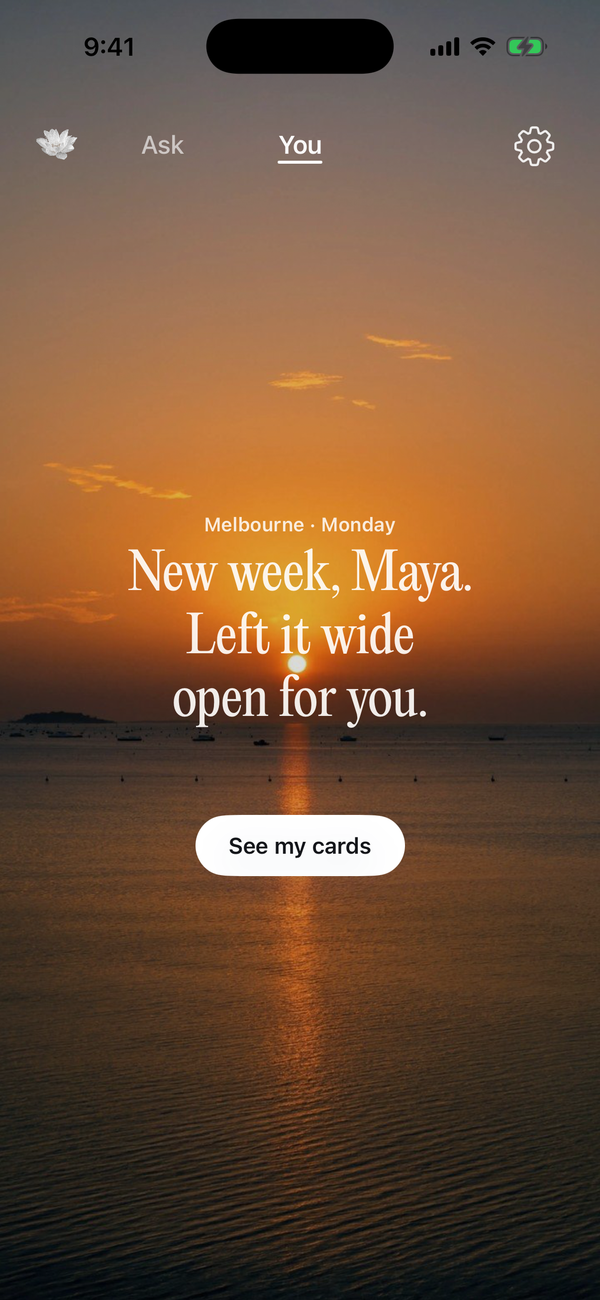
Natus does not give you a job list and it does not score you against other people. It starts from your name and birth details to build a first picture of how you tend to operate, then reads what you write against that picture over weeks, so your real days become the measure instead of a quiz taken once.
Two honest notes, in the same spirit as this page. Natus does not predict your future, and it is not a clinical or diagnostic tool.
If you want the non test route to the same question, what career suits me is the closer read, and who am I without my job covers the version where work has been carrying your whole identity. How to find what you are good at is the practical companion, and the career personality test page covers what the personality flavoured versions add and what they miss.
See what you're naturally good at and get your first reading free.
Common questions
- Are free career tests any good?
- They are good at one job: giving you names for kinds of work you had not considered. They are poor at deciding your career, because they measure interest and preference, not your performance, your commitments or what the market pays.
- How can I tell a weak career test quickly?
- Three signs. It asks only what you like and never what you have done. It explains nothing about how it scored you. And the result arrives behind an email form or a paid report. A serious free test tells you what it measured before it tells you what you should be.
- What is the best free career test for adults?
- For interest, a government or college run interest inventory is the safest free option, because it is not selling you anything. For a full picture, pair an interest result with your own work history: what you were asked to do again, what you recovered from fastest, and what you would still do unpaid.
- Why do free career tests disagree with each other?
- Because they measure different things. One sorts interests, another sorts personality, a third sorts work values. Where two results disagree, you have learned something real: you sit between two lanes rather than inside one, and the disagreement is the finding.
- Do career tests help if I already have a career?
- They can, mostly as a prompt. Adults already hold better evidence than any quiz, which is a work history. The test is useful for naming a direction you had not put into words, and close to useless as a verdict on what you should do next.