What is a dismissive avoidant attachment style?
What a dismissive avoidant attachment style feels like from the inside: self-reliance as protection, why closeness feels costly, and how to recognise it.
Reading time: 6 min
Dismissive avoidant attachment is the pattern where closeness feels expensive and self-reliance feels safe. People with this style often describe themselves as independent, low-maintenance, and hard to pin down. From the inside, it does not feel like a problem. It feels like competence: you handle things alone, you do not need much, and you are not easily rattled by other people's opinions.
The quieter cost is that needs, emotions, and closeness are kept at arm's length, often without noticing. This page is not about turning that into a label or a diagnosis. It is about seeing how the pattern works, so you can decide when the self-reliance is truly protecting you and when it is quietly costing you the closeness you actually want.
What may be happening
Dismissive avoidant attachment often forms in a childhood where emotional needs were seen as too much, inconvenient, or weak. The lesson learned is practical: needing things from people is unreliable, so do not. You become your own safest place. Wanting less becomes the strategy, and being able to leave quickly becomes the security.
As an adult, that shows up as a quiet rule: I am better off handling this myself. The rule is so automatic it usually does not feel like a rule. It feels like how you are. You can go long stretches without reaching for people, feel fine about it, and honestly believe you are not avoiding anything.
The room where it costs you is usually in the moments after closeness. A tender conversation, a moment of being seen, a partner who wants more. The closer someone gets, the more the old lesson activates: this is too much, this is unsafe, I need space. The feeling is not fear on the surface. It can be irritation, boredom, or a practical urge to get back to your own life.
How it tends to show up
- You are the "easy" partner or friend: calm, flexible, never needy
- You feel restless or slightly bored when someone becomes more available
- You recoil from being depended on, and say so plainly
- You keep relationships at a comfortable distance without deciding to
- You notice yourself focusing on a person's flaws right when things get warm
- You are proud of not needing others, and quietly lonely in the same breath
Why awareness alone may not change it
Knowing you have this pattern does not automatically soften it, because the pattern is doing real work. It is protecting you from the thing you learned early: that needing someone hurts. Awareness becomes useful when it moves from "I am dismissive avoidant" to "I create safety by not needing anyone, and I can see what that costs me."
It also helps to see the difference between solitude you choose and distance you cannot close. One is true independence. The other is a wall that looks like independence from the inside.
Where this connects
Dismissive avoidant is one end of the avoidant spectrum, and it differs from fearful avoidant attachment, where the same wall comes with longing and anxiety behind it. Both often show up as pulling away when someone gets close. Seeing all four patterns side by side helps you recognise which one is actually running in you, instead of guessing from a label.
A question worth carrying
What would you lose if the people closest to you truly needed you?
How Natus approaches this
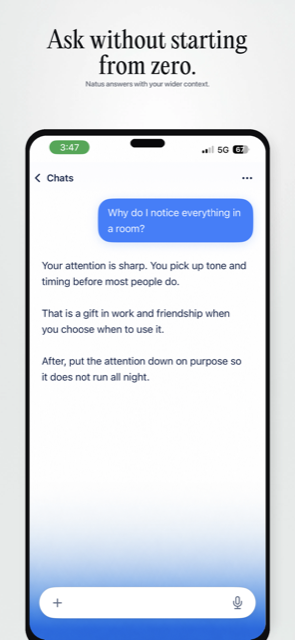
Natus starts with a personal map of how you operate, so a pattern like this becomes something you recognise in the moment you are living it, not just in hindsight. It reads your week back against that map, built for recognition rather than labels, diagnosis, or relationship homework.