Why does my personality test result change every time?
If your personality test result changes every time, that is usually the test working as designed. What it is measuring, what moves it, and what it cannot see about you.
Reading time: 6 min
Your result changes because the test is measuring how you answered that set of questions on that day, not a fixed object inside you. Most tests put you on a line between two preferences, and where you land moves with your mood, the week you have had, and how you read one sentence. A result that shifts is usually the test behaving as designed. A result that never moves is worth a second look too.
So the useful question is not which result is the real you. It is what the movement is telling you, and which parts held still.
What may be happening
You took the test again because the first result did not fully land. Maybe it felt close, but one letter was wrong, or the description read like someone slightly nicer than you. So you answered the questions a second time, more carefully, and got a different type.
There are two common reasons for that. The first is that the test asks you to agree with statements about yourself. Those statements are abstract, and people are bad at rating themselves in the abstract. What you actually do at a family dinner is easier to know than whether you are "more feeling than thinking" in general.
The second is that most type tests are built on pairs, and most people sit near the middle of at least one pair. If you are two points either side of the line, a small change in mood is enough to flip the result. The test did not discover a new person. It rounded a soft edge in a different direction.
How it tends to show up
- You take the test twice in a month and get two types, and both descriptions feel about 80 percent right.
- You answer differently when the test is sent by a friend than when you take it alone.
- You notice you are answering who you would like to be, not who you were last week.
- One result arrives during a hard month and reads like a description of the hard month.
- You keep the result that flatters you and quietly forget the other one.
- You use the type to explain a choice you already made.
- You read the same result a year later and it feels less accurate, not more.
- Someone describes you in one sentence and it lands harder than the whole report.
The last one is the most useful thing on the list. A single sentence from a person who knows you beats a four letter code, because that person has watched you behave.
Why awareness alone may not change it
A test can give you a word for a pattern. It cannot show you the pattern happening. That gap is why people collect results for years and still feel like they are guessing.
There is also a matching problem. The descriptions are written to fit a lot of people, because a test that only fit 2 percent of readers would feel broken to everyone else. So you read a warm, broad paragraph, recognise yourself in it, and assume the test saw something. What you recognised was your own knowledge of yourself, reflected back in better words.
None of that makes tests worthless. It makes them a starting language. The thing they cannot measure is what you do next: how you behave when you are tired, what you avoid, what you keep returning to, and where the same week keeps catching you out. That record is yours. No questionnaire has it.
A question worth carrying
Next time you take one, keep the answers rather than the type. Write down the two or three questions you hesitated on, and what you wanted to answer instead. That hesitation is the only part of the test that is not a category. It points at something you are still unsure about, and that is more useful than a label you are sure about.
How Natus approaches this
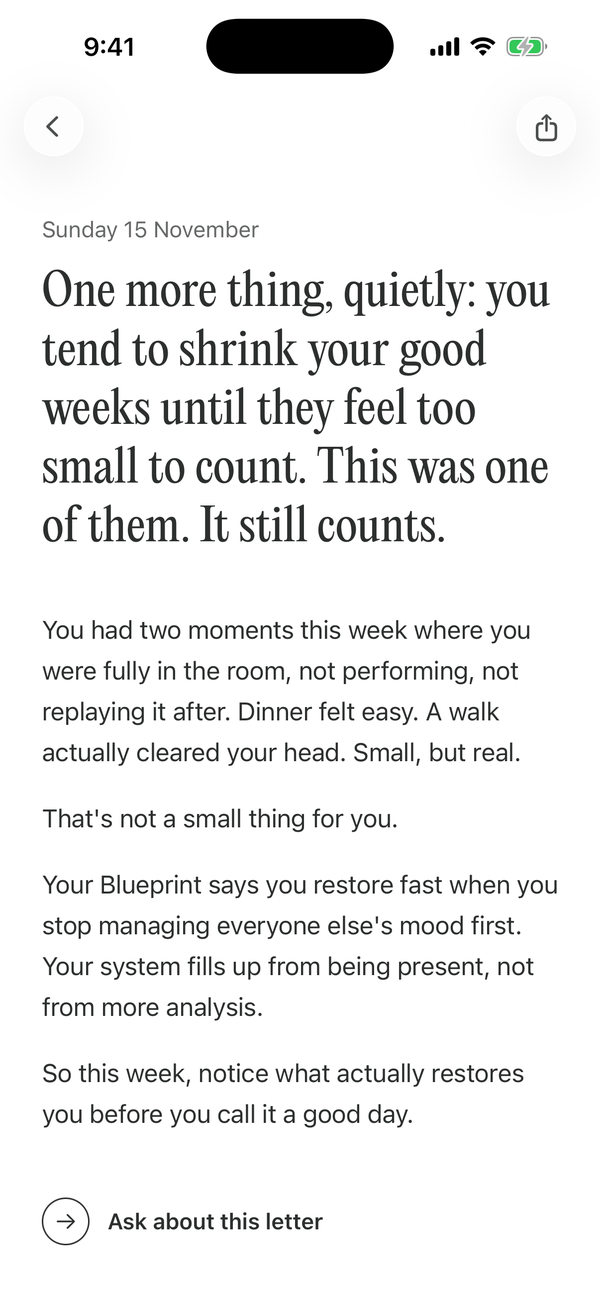
Natus has no quiz and no score. It starts from your name and birth details and builds a personal map, then over weeks it reads your own writing and asks back the things you keep circling. The evidence is your actual days rather than your agreement with statements, which makes it slower and harder to fake, and it is not a measurement.
If you want to see how a test holds up, why the same reading can feel true for anyone is the honest place to start. How accurate a personality test can really be covers the retest question. And if you are still choosing one, what to look for in a free personality test will save you an email address or two.
See what you're naturally good at. Get your First Reading.
Common questions
- Why do I get a different result every time I take a personality test?
- Most tests place you on a line between two preferences, and the line moves with your mood, your week and how you read the wording. If you are close to the middle on a pair, a small shift is enough to flip the letter. That is not a flaw in you. It is the test measuring a soft edge.
- Is my personality test accurate?
- It is accurate about the answers you gave, which is a narrower claim than it sounds. A test cannot check whether you described yourself honestly, and it cannot watch what you actually do on a Tuesday. Treat the result as a description of your answers, not a measurement of you.
- Which personality test should I take?
- Take one that names the model it is built on and shows your score on a range rather than a single box. A free Big Five questionnaire does that. Take the same test twice, a few weeks apart, and compare the numbers. The stable parts are the interesting ones.
- Can my personality type change over time?
- The words you use about yourself change more than the underlying tendencies do. Most people read differently in a hard year than a calm one, and a test taken during a hard year will say so. What tends to stay is the way you handle pressure and where your attention goes first.
- Is Natus a personality test?
- No. Natus has no quiz, no score and no type. It starts from your name and birth details, then reads your own writing back to you over weeks. That is slower than a test and better at showing patterns, but it is not a measurement.