What is the Big Five personality test?
What the Big Five personality test actually measures, where to take a free version, and why it is the least flattering result you will get.
Reading time: 8 min
The Big Five personality test scores you on five scales: openness, conscientiousness, extraversion, agreeableness and emotional stability. You do not get a type, a colour or four letters. You get five numbers and a profile, which is why it is the least quotable personality test and the one with the strongest research behind it.
Short answer first: it is the best available description of how you currently operate, and it is still only a description. It cannot tell you what you are good at, what you will do next year, or how you behave in a week that breaks you.
What may be happening
You have taken a four letter test, found it memorable and slightly unsatisfying, and someone told you the Big Five is the serious one. Now you are looking for the version that is actually true.
Here is what each scale means, in plain words, with what a high and a low score tend to look like in an ordinary week.
- Openness. How much you reach for new ideas, unusual art, and unfamiliar ways of doing things. High: curious, comfortable with ambiguity, bored by routine. Low: prefers the proven way, suspicious of novelty for its own sake.
- Conscientiousness. How much you plan, persist and finish. High: reliable, tidy, uncomfortable leaving a task half done. Low: flexible, spontaneous, allergic to admin.
- Extraversion. How much other people charge you up. High: thinks out loud, seeks company, energised by a room. Low: restores alone, prefers depth to volume, finds a full day of people expensive.
- Agreeableness. How much you accommodate other people. High: warm, cooperative, slow to fight. Low: direct, sceptical, willing to be unpopular.
- Emotional stability. How much your mood holds under pressure. High: even, hard to rattle, sometimes slow to notice a problem. Low: sensitive, quick to feel, quick to spot trouble.
The useful part is that these are scales, not boxes. Scoring in the middle of a scale is common and it means exactly what it says: you move with the situation. A type test has to break that tie for you. This one does not.
How it tends to show up
- Your result is mostly middling, and you feel vaguely cheated because nothing dramatic came back.
- One scale is clearly at an end, and it explains a recurring argument in your life.
- You score high on conscientiousness at work and low at home, which means the test measured a role, not a person.
- Your score on emotional stability drops sharply in a hard year, and you assume the test was wrong the first time.
- Nobody wants to hear your result, because there is no label to repeat at dinner.
- You recognise yourself in the low score you did not want, more than the high one you liked.
- You retake it six months later and the shape is broadly the same.
Why awareness alone may not change it
Knowing your five scores changes very little on its own, because the scores describe the outside of the pattern rather than the mechanism.
There is also a timing problem. The test measures how you answered in that hour, in that mood, in that season of your life. Someone who has just changed jobs will score differently than the same person six months into the role. That is not a flaw in the test, it is a fact about self-report, and it means any single result is a snapshot with a date on it.
The deeper limit is that the Big Five was built to describe differences between people, not to explain a single person. It can tell you that you are low on conscientiousness compared with most people. It cannot tell you which tasks you abandon, at what point in the task you abandon them, or what would make you finish. Those are the questions that change a week, and they need a record rather than a score.
Two runs of the same test a year apart, read side by side, are more useful than one result read closely. The movement between them is the interesting part.
A question worth carrying
On which scale did my score describe the role I am in rather than the person I am, and what would it look like outside that role?
How Natus approaches this
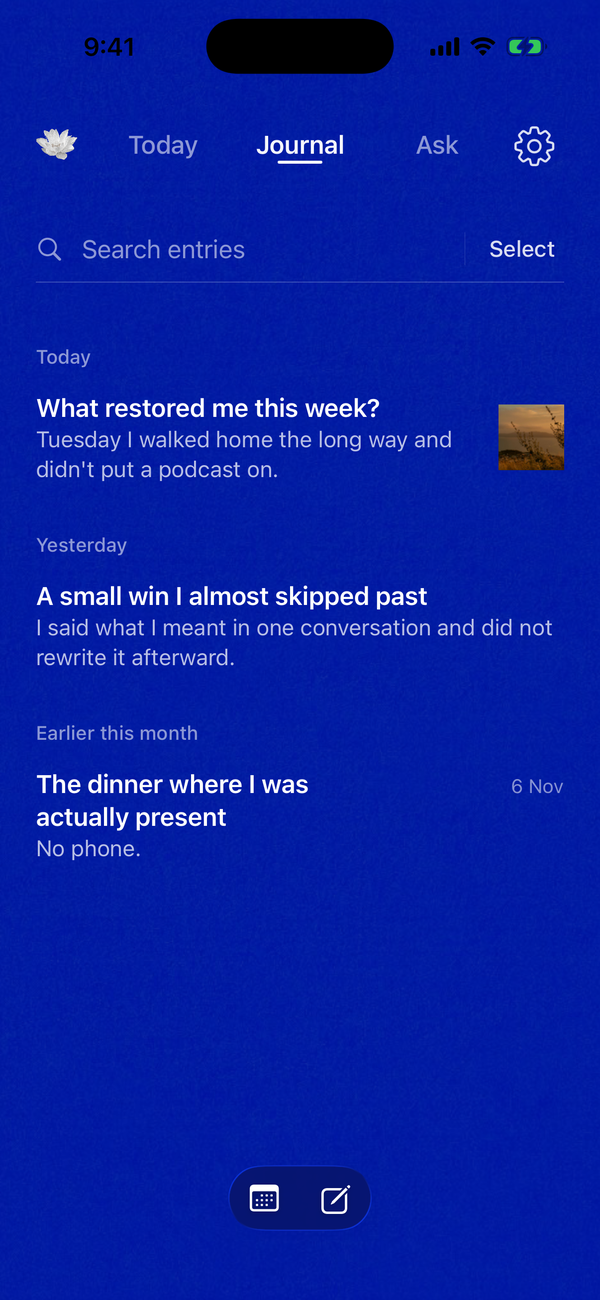
Natus does not run a questionnaire, so it cannot hand you five numbers to compare with your last set. It starts from your name and birth details and builds a personal map, then over weeks it reads your own writing and reflects the pattern back to you. Where a Big Five result gives you a score with a date, this gives you a record that keeps growing, and the evidence is your behaviour rather than your self-description.
If you want to compare families of test, which personality types test to take covers the whole field, and what a free personality test can and cannot tell you is the honest version of the free tier. What the 16 personalities letters mean is the fair comparison if you are weighing the two models up.
See what you're naturally good at. Get your First Reading.
Common questions
- What are the Big Five personality traits?
- Openness, conscientiousness, extraversion, agreeableness and emotional stability, often written as OCEAN. You get a score on each scale rather than a type, so two people with the same overall picture can still differ on every individual score.
- Is the Big Five the most accurate personality test?
- It has the strongest research base of the main models and it holds up best when people retake it. That makes it the most reliable description of how you answered, not a prediction of what you will do. No self-report test can measure your ability or your circumstances.
- Where can I take a free Big Five test?
- Many universities and research groups publish free versions built on public question sets, and the IPIP based questionnaires are the most common. Look for one that shows your score on each of the five scales and says how many questions it uses. If a site withholds the result behind an account, that is the price.
- Is the Big Five better than MBTI?
- They answer different questions. The Big Five gives a more reliable and more granular picture of how you currently operate. The MBTI and 16 types style tests give a label that is far easier to remember, discuss and use in a team. Big Five for accuracy, four letters for conversation.
- Does Natus use the Big Five?
- No. Natus does not run a questionnaire or score your traits. It builds a personal map from your name and birth details, then reads your own writing back over weeks so the patterns you keep repeating become visible. It is a reflection tool rather than a measurement.